Starting the Writing Process

Photo by Photo By: Kaboompics.com on Pexels.com

Whether you’ve had six books published or you are a new writer, getting started can be a challenge. Writing is a process, not merely a product. The quality of your writing will be reflected in the thought and time you put into it.

Having a deadline can be helpful. If you have an editor waiting for your final draft or you have an assignment due, this is a motivation. If you don’t, you can set one for yourself. I often do.

Planning ahead is a good place to start. Sn outline is even better. You don’t have to actually write, you can just think about what you want to say and plan ahead. When you do sit down to it, you’re that much ahead. Then schedule a few writing sessions. That way if you’re not feeling like it, or if you want some revising time, you can return to it later. I rarely finish a piece in one sitting.

Topic and audience are often interrelated. Think about what you want to say to your audience and how that informs your topic. Ask yourself who the audience is, Why is your audience interested in this topic and what do they already know, if anything, about it. What of you think your audience would/should gain from your text?

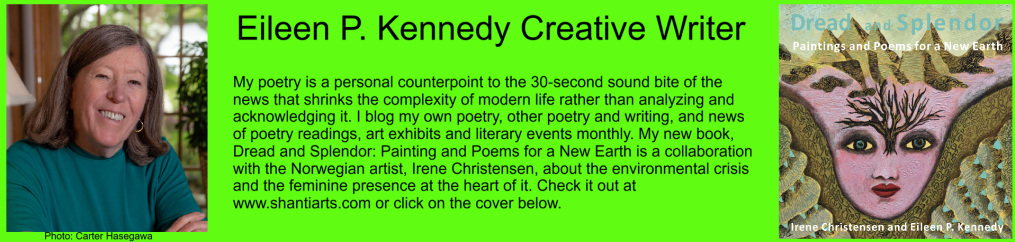
Think about the purpose of your writing. Why are you writing the piece My most recent book, a collaboration with the Norwegian artist, Irene Christensen, was inspired by her paintings about women at the heart of the environmental movement. It’s called Dread and Splendor: Paintings and Poems for a New Earth. I wanted to respond poetically to Irene’s work, but I also wanted this to raise awareness of the environmental crisis.

My new book will be out in early 2026 from Shanti Arts. I will keep you apprised of the publishing process on it. Follow me here monthly.

Titles

Photo by Mark Neal on Pexels.com

Titles of books, short stories, poems, are very important.

Corporations spend millions to find the name of a product. Thought should be put into how you title your creative product.

Let’s discuss book titles. The first thing anyone hears about is the title of your book. It even precedes the cover. Once the artist knows what the title is, he/she can work on the visual concept. Think about what you will call your book. Here are some things to think about:

.It should give an idea of what the book is about.

.It should be easy to say.

.It should be memorable.

.It should grab your attention.

When we were deciding on a title for our manuscript, Dread and Splendor: Paintings and Poems for a New Earth, we tried out a lot of titles. The first one was “Dreadful Splendor” from a W.B. Yeats poem. This was taken by a previous book, so we changed it to “Dread and Splendor.” We thought this encompassed the “splendor” of the art and poems and the “dread” of the environmental crisis. Then we decided this didn’t really tell what the book was about and we added the subtitle “Paintings and Poems.” At first we had “Paintings and Poems for a New Planet.” But then we thought it sounded too much like speculative or science fiction. So it became “Dread and Splendor: Paintings and Poems for a New Earth.”

The same is true of a short story, poem or play title. Editors look at hundreds of poems and short stories.

If you follow the guidelines above, you’ll draw attention to your piece from the beginning and have less change of being passed over.

Sometimes for titles a phrase can be used from the manuscript can be just the right thing. If you have a concept that is long, write it down and then edit it.

Try discussing your book using the title and seeing if people understand and appreciate what you’re saying. See if they ask questions and are interested in the title and what you have to say.

Choosing the perfect title is mostly about trial and error. If you try out a number of titles, the best one becomes clear.

I will be blogging monthly, taking about the production of Dread and Splendor: Paintings and Poems for a New Planet through publication and beyond. Follow me here.

From What Perspective Do You Tell Your Story

Voice is a rather abstract concept in writing and fiction generally. But it’s so important that it deserves mention as one of the core aspects of writing. Voice, quite simply, is what the narrator sounds like. Voice includes the narrator’s emotions, attitudes, perspective, and tone.


As you read the piece, you can hear the narrator’s voice in your head, and the voice leaps out in a particular and funny way. This is especially true in pieces where the narrator is some kind of interesting or unusual character.

Photo by Pixabay on Pexels.com

Additionally, voice is multi-layered. It includes both the general writing voice of an author, as well as individual voices that are tied to specific pieces of writing. In poetry, you can write a narrative poem in all kinds of voices.

Some writer’s tones are incredibly distinctive, and their sentence structure, length, word choice, and the way the paragraphs flow are original to their writing. In a longer literary work, readers will likely come across different voices as writers create different characters. When considering the difference between the author’s voice and the character’s voice, it’s important to pay attention to when one is used. A character’s voice is specific to a character in a literary work. It is created in order to define them as an individual. Readers should be able to tell the difference between major characters based on their  speaking. One character might be well-educated and prone to using large words, while another might have more basic education and find the former’s use of language elitist.

When using a third-person narrative, the narrator is omniscient or outside and telling about the action. “Half a league, Half a league onward, into the valley of death, rode the six hundred.*” is a famous example of third-person narrative.

First-Person narrative is another way to tell a story. Edna St. Vincent Millay’s “What My Lips Have Kissed and Where and Why” begins “What lips my lips have kissed, and where, and why, I have forgotten, and what arms have lain under my head till morning; but the rain Is full of ghosts tonight, that tap and sigh…” Or this famous line from “The Telltale Heart,” by Edgar Allen Poe It was the beating of the old man’s heart. It increased my fury, as the beating of a drum stimulates the soldier into courage.” The speaker of a first-person narrative does not necessarily have to be the author, but can be totally invented.

However you choose to tell your story, choose your narrator wisely. It will really make a difference in your piece. Follow me here the beginning of the month as I blog about writing, the writing process, and publishing.

*”The Charge of the Light Brigade,” by Alfred Lord Tennyson.

Submitting Poetry to Online Journals Who Accept New Writers

Photo by William Fortunato on Pexels.com

Finding the right home for your poetry can take a lot of time and research. I often submit to online journals because I want to demonstrate to my book publisher that there is a market for these poems. One way of doing that is to have literary journals publish them. These then become the “Acknowledgements” at the back of your book manuscript.

Another reason to submit online is because it builds your portfolio when you’re trying to submit to more prestigious print journals. Online journals can be a great first place to submit when you don’t have many or any publications.

Here are some places to start:

Barren Magazine https://barrenmagazine.com/ publishes monthly in all genres. They lean toward introspective poetry.

Euonia Review https://eunoiareview.wordpress.com/submissions/ accepts original poetry as well as reprints, but you must retain the rights to them. They also respond quickly, sometimes within 24 hours. They accept up to 10 poems at a time.

The Meadow https://authorspublish.com/the-meadow-now-seeking-submissions/ publishes both in print and online. They publish multiple genres of new and established writers. They nominate for the Pushcart Poetry Prize, so if you get published by them, you are eligible for this prize nomination.

Ghost City Review https://ghostcitypress.com/submit publishes in multiple genres, but do not accept simultaneous submissions. This means you can only submit to them individually and not to other journals at the same time.

Roses and Wildflowers https://societyforritualarts.com/rw/2024-spring/submission-guidelines/ publishes on themed issues. They publish in Spring and Fall and there is always a theme. Check their website for themes.

Starry Starry Kite https://starrystarrykite.substack.com/about is published monthly and welcomes new and established writers. They also do interviews with featured writers.

When I submitted my manuscript, Dread and Splendor: Paintings and Poems for a New Earth for publication, I had several acknowledgements from different journals, including online ones like Starry Starry Kite and Wordpeace. This assures the publisher you’re submitting to that journals were already interested in publishing some of the work in the manuscript. We submitted to four publishers and got offers from two. We ultimately wound up signing with Shanti Arts. The book should be out in early 2026.

Follow the journey of my book, Dread and Splendor: Paintings and Poems for a New Earth, which is a collaboration with the Norwegian artist, Irene Christensen. I will blog about it here on Thursdays.

How to Enhance Your Story

Writing a good story is essential to any genre. Story writing is a key element of being a competent writer.

If you want to be as complete a writer as possible, it is important that you know  how to write a good story. Story writing is a common skill for most writers, it is something that most writers take for granted. In truth, you must develop your writing skills to the best of your abilities.

If you want to reach your full potential as a writer, you will need to tell a truly great story. Before you start writing your story though, you should make sure you know what story writing really is, and what the elements are needed. The five elements of a story are character, plot, setting, conflict and resolution.

Photo by Suzy Hazelwood on Pexels.com

This is simple enough, but how do you make your story stand out?

One way to do this is to have your manuscript reviewed by a more experienced writer. There are many writers you can hire to do this or you can join a writing group. A good writing group will put everyone on an equal footing where everyone reads and the group comments on the piece. This can be done in a generative group, where everyone is writing something new right there and everyone shares or a critique group, where a manuscript, or part of one is sent out in advance by a group member and then the group reads it and offers critique. This route can be more difficult to do than paying a consultant, because you will want to feel comfortable with how the group operates before you can feel the feedback is helpful.

I was writing a collection of eco-poetry because I am passionate about climate justice. Then I met the Norwegian artist, Irene Christensen, who was doing a series of paintings about women at the heart of the environmental movement. We decided to collaborate and came up with a 60-page manuscript called Dread and Splendor: Paintings and Poems for a New Earth.

Another way to improve your story writing skills is to read other stories. I try to read something new on a daily basis. The more you delve into new literature, the more concepts and ideas will find their way into your own story writing.

But the most important thing to remember about being a good writer is to keep at it. A good writer writes everyday. Even if what you’re writing that day is not going well, if you keep at it, you’ll eventually get to something that works. You can’t sit down the first time and tell a wonderful, well-written story. It takes practice.

Follow me here on Thursdays. I will be writing about the writing/publishing process and the progress of my manuscript Dread and Splendor: Paintings and Poems for a New Earth.

Create An Outline for Your Manuscript

An outline for your manuscript to is a great way to start a large book project.

Photo by Ron Lach on Pexels.com

Create an Outline

First you want to structure your raw idea into an organized manuscript format. This is where the outline becomes invaluable. Hopefully you have done some research before this stage and have a definite idea of how your manuscript would fit the lists of certain publishers and the overall book market.

Think about a logical sequence and flow. When I do a poetry manuscript, I think about a theme and how my recent poems fit into this theme. I might even have subsections. When I wrote Touch My Head Softly, which was about my partner and Alzheimer’s Disease, it naturally fell into three sections, before, during and after the death. When it came to publishing, my publisher immediately recognized the organization and acknowledged how it would fit into Finishing Line’s line of books for the season.

After you have shaped your outline, you can structure your material into an organized manuscript format. This is where your outline is invaluable. Think about the logical flow and sequence and divide your poems or ideas into coherent chapters and/or subsections.

If there is a chronology that makes sense, then present your content in that way. Determine what information and material belongs in the beginning, middle or end. In the end you will have a well-organized manuscript that you can present to a publisher.

This is what I did for my most recent manuscript, Dread and Splendor: Paintings and Poems for a New Earth. I will be blogging on Thursdays. Follow the progress of my manuscript here.

How to Avoid Distractions While Writing

Photo by Porapak Apichodilok on Pexels.com

It’s really easy to get distracted when writing, especially now that we’re all often working at home. Phone calls, emails and housework all conspire to take away the writing time.

Losing focus while in the middle of writing can seriously damage the quality of your content, The human brain takes around 17 minutes to refocus on a task after a distraction. If you want your writing to be the best quality content possible, you need to get rid of distractions. Billy Collins, the former Poet Laureate of the U.S., suggests sitting with your idea and writing until the complete thought is down,

You can disable notifications on your computer and delay household chores until after writing.If you put your writing first, you get more accomplished and the quality of the content will be better.

During the pandemic I wrote a collection of poetry and had it published.  I did this by focusing.  Take a look at the book:

https://www.finishinglinepress.com/product/touch-my-head-softly-by-eileen-kennedy/

Writing as a Business

Photo by Andrew Neel on Pexels.com

Years ago, an artists success was determined by art critics, collectors and publishers. Today, this has changed. Today these people are no longer in power and the writer is often an entrepreneur if she/he wants to make an income from her/his writing.

Vincent Van Gogh chose not to go commercial and only sold a few paintings in his life. Andy Warhol created The Factory to create and promote his work as an assembly line process. Writers also fall into different categories of commercialness. Some just prefer not to publish and read and write within circles of writing groups and friends. Others put a lot of effort into reading, blogging, working with publishers, etc. in order to sell copies. Some writers publish and promote their own books, while others publish with publishers and work in conjunction to promote the book.

Today’s artist/writer may have to brand their work, build an online presence, and stay aware and use social media trends. Margaret Atwood, with her book Testament, the sequel to A Handmaiden’s Tale, attracted hundred of fans to her book launch in London by having women dressed in red capes and white bonnets. She also simulcast it in three cities. She has been on the best-seller’s list many times.

Writers have to develop other skills besides writing to sell copies of their books. This means taking advantage of social media, blogging, and podcasting in order to reach potential customers. A writer has to decide how much time she/he wants to spend on promotion, which does take away from the creativity.

Check out my new collection of poems at: https://www.finishinglinepress.com/product/touch-my-head-softly-by-eileen-kennedy/

Journaling as a Source of Inspiration

A piece of writing begins with a germ of an idea, an inspiration, a straw dog. Some people use their journals to spark ideas.

Photo by Tirachard Kumtanom on Pexels.com

I have been journaling for many years. I used to use pen and a notebook. Now I journal on my Microsoft Word App on my iPhone. I just find that while I may not always have my notebook, I tend to always have my phone. I journal snippets of ideas that I may later develop into a writing piece or poem. Do you journal? When? How?

I have a new collection of poetry out that started with my journal. It will be out soon from Finishing Line Press:

https://www.finishinglinepress.com/product/touch-my-head-softly-by-eileen-kennedy/

Or you can find it on Goodreads:

https://www.goodreads.com/review/show/3609820860https://www.finishinglinepress.com/product/touch-my-head-softly-by-eileen-kennedy/

“I read the way a person might swim, to save his or her life. I wrote that way too.” –Mary Oliver

I am a writer and a swimmer and really related to this quote from Mary Oliver, the great Pulitzer-Prize winning poet. During this dark pandemic period, I find both writing and swimming have sustained me. I’m grateful I get to reserve a lane at my gym and swim six days a week (never on Sunday.) I have also been writing through this pandemic and I feel like it has been a lifesaver. It gives me purpose.

I wrote a collection of poems about my experiences with my partner, who died of Alzheimer’s in his sixties. I feel grateful that Finishing Line is publishing this work and it will be out in the world. The work around the publication, particularly, has sustained me during this dark time.

This is the link to my book at Finishing Line:

https://www.finishinglinepress.com/product/touch-my-head-softly-by-eileen-kennedy/

This is the link to my book on Goodreads:

https://www.goodreads.com/review/show/3609820860https://www.finishinglinepress.com/product/touch-my-head-softly-by-eileen-kennedy/

Photo by Ingo Joseph on Pexels.com