On Using the Pause in Your Writing

Photo by Ekaterina Pashkevich on Pexels.com

“How much better it seems now, than when it is finally done. How hungrily one waits to feel the bright lure seized, the old hook bitten.

–Dana Gioia

Writers have been using “the pause” in their writing for a long time. This is a space between writing sessions where the writer breaks off before the piece is finished, and think about the piece in between. Many famous artists used this method from Hemingway to Beethoven. For creatives, it’s a way of keeping going when you know something is unfinished.

This “pause” taps directly into the creative process. Unfinished tasks stay in the psyche and urge the artist to be finished. Hemingway liked to stop in the middle of a sentence. Then he would think about the passage he had left behind until he was able to return to his work.

Artists don’t finish great works in one sitting anyway. Picasso would start multiple paintings at once and pause before each one was finished. Maya Angelou would stop mid-paragraph, if she felt it wasn’t going quite right. Pausing creates a discomfort for the artist. The artist is uncomfortable when the piece is left unfinished and wants to get back to it, maybe after many pauses, and finish it. The pull of the unfinished will bring the artist back to where he/she left off.

The pause is not complicated. It’s not something that requires hours of training or discipline. It’s just the call of the unfinished; the itch that needs to be scratched; the natural calling back to the page.

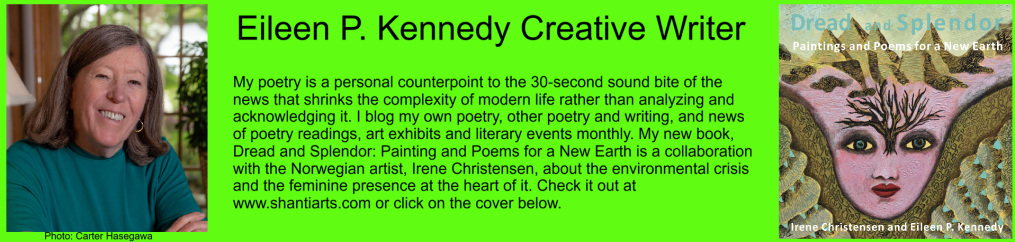
When I wrote my latest manuscript, Dread and Splendor: Paintings and Poems for a New Earth, it took me two years. It was my first collaborative effort with the Norwegian artist, Irene Christensen. We started the project in Costa Rica, where we had casitas close to each other in an artists colony, but later there were many pauses as we communicated across continents. She met me at my house in Massachusetts and I met her several times in New York City. But most of the reconnecting was done via internet or phone.

The manuscript has now been accepted by two publishers and there will be pauses and reconnecting again as we move forward with our new publisher, Shanti Arts. I will blog on Thursdays. Follow me here.

Sometimes We Have to Gather Tomatoes to Write

I plant tomatoes every spring

Their small green selves

Growing shockingly tall

And flashing yellow flowers

That turn to rich red fruit

Juicy as I pop them in my mouth

Photo by Julia Nagy on Pexels.com

I wrote this on a winter’s day longing for summer and its fruit and vegetables.

This blog is intended for the part of you that is longing for a moment in the sultry sun.

Can you feel the fresh breezes coming?

Remember the time you bought tomatoes at a roadside stand. You ate them all by yourself or with a lover or a friend.

In order to write, take your shoes off, get rid of your bags, and all the items that keep interrupting your experience in this summer moment.

Recall some happy summer, some years ago, when you did this sort of thing.

If you do this sort of thing and poems will happen because of it. We need time and space for reflection.

Visit me here on Thursdays when I will blog about the writing process, poetry and publishing.

Writing Distracted

It’s really easy to get distracted when you write, especially now that we’re all largely home working and there are phone calls, emails and housework all conspiring to take away the writing time.

The human brain takes around 17 minutes to refocus on a task after a distraction. Losing focus while in the middle of writing, can seriously damage the quality of your content. If you want your writing to be the best quality content possible, you need to get rid of distractions.

Disable all notification on your computer and put your phone on silent so that you do not get disturbed in the middle of a writing session.  Be disciplined enough to either do your housework  before you write, or better yet, delay it until after your writing session.

Photo by Andrea Piacquadio on Pexels.com

If you put your writing first, you get more accomplished and the quality of the content will be better.

During the pandemic I wrote a collection of poetry and had it published.  I did this by focusing.  Take a look at the book:

https://www.finishinglinepress.com/product/touch-my-head-softly-by-eileen-kennedy/

Writers and Isolation

Writers write in isolation mostly. This can be both challenging and rewarding. Sometimes it’s in small groups or workshops, but mostly alone. Sometimes I wait until the last minute to write what I want? Why?

In the end, I try to listen to my inner voice that speaks my true thoughts that ultimately helps me cut through the nonsense that sometimes enters into my writing. Good writing comes from the true self.

Photo by furkanfdemir on Pexels.com

I use different methods to get in touch with my inner self. I meditate, move to a coffee shop or library, read a book of an author who is writing something similar to my project. Sometimes just sit quietly.

Join me in imagining and getting in touch with your inner self. Try writing from that one true voice.

If you’re writing in isolation, it’s probably because you love the craft, because you can’t not write. Sometimes this is in a group, or a library, or a coffee shop, but mostly it’s in isolation.

I’ll continue to blog on Thursdays. If you’d like me to make an announcement for an upcoming reading, publication or award, get in touch with me here.

Using Creativity to Navigate the World

Photo by Karolina Grabowska on Pexels.com

With all the problems in the world, many of us are involved, to survive, in self-preservation behaviors. Creative activity can be a part of self preservation.

Think of increased creative capacity as growth.We should take creative actions to improve our creative growth. If we write a poem in a new form we’ve never used before, that can read to creative growth, for instance.

People who are creative are happier, healthier, and less lonely. A published poem can lead to a reading, a painting to an exhibit, a song to a concert. All of these things put us, and our art, out into the world to see and be seen and to interact.

A creative ability is a skill to use our imagination to solve a problem. We may feel stuck with a problem, but if we read up on how other people have solved this, or ask a friend how they solved this, we are using creativity to problem-solve.

You don’t have to be an artist to exercise your creative ability. You can use this skill to fulfill dreams, problem solve, and improve communication skills.

I’ll be blogging on Thursdays. Follow me here on WordPress.

Reading Deprivation

Photo by Pixabay on Pexels.com

For writers, reading is a way of life. We read early and often. We read, we write. We check our media contacts, read newspapers or magazines online or in hard copy, then read a text of something similar to what we are working on in our own writing. If we stop reading, it’s deprivation.

It’s a paradox that by emptying our lives of all that text and distraction, we are actually refreshing the wellspring. By absenting ourselves from all the media, we get in touch with our inner selves, which is where all the creativity comes from. By keeping the inflow to a minimum, the outflow improves. Our true thoughts and feelings will begin to penetrate and come out in new writing, running freely. I knew a playwright who would take off his shoes and socks and stand in a running stream with a paper and pencil to literally get his flow going.

If you find not reading difficult, and many writers do, here are some suggestions:

.listen to music that has no words

.sew

.repot plants

.cook a complicated, time-consuming recipe and then

.invite friends to dinner

.watercolor

.rearrange the kitchen

.exercise

.meditate

.dance

After a number of these activities, sit down and write again. Notice any differences in your feelings or content. Your writing may benefit.

Follow me here on Thursdays.

Using the Library for Writing

Photo by mentatdgt on Pexels.com

I was struggling with writing a poem about a historical incident. I just couldn’t find a way into the poem. I tried locking myself in my study, ignoring the phone when it rang, procrastinating with housework, but nothing worked.

Then a writer friend of mine made a suggestion. Go to the Library. I live in Massachusetts where every town has a town library, but it just didn’t occur to me. I’ve read many articles and blogs on how to focus as a writer, but I hadn’t tried my local library.

I organized my writing materials as best I could, convinced I would leave important things at home that I would need there. I allowed for time to get to and from the library (about eight minutes each way. ) I carried my computer and notes to the car and set off.

When I arrived there, I found a lovely place to sit, a desk with partitions that actually blocked me from other desks. It was quiet and I easily tuned my computer into the wifi, and soon enough I was writing a rough draft. I came to a point where I needed to confirm some historical information, and the reference librarian was at the ready to help.

I wound up bringing the draft home and finishing it there. I recently submitted the poem. I don’t know if it will be accepted, but at least I finished it and it’s off my desk.

I’ll be blogging on Thursdays and doing announcements on Tuesdays as they come along. Follow me.

Listening to Your Inner Voice

Writers write in isolation mostly. Sometimes it’s in small groups or workshops, but mostly alone. Sometimes I wait until the last minute to write what I want? Why?

In the end, I try to listen to my inner voice that speaks my true thoughts that ultimately helps me cut through the nonsense that sometimes enters into my writing. Good writing comes from the true self.

Photo by John Diez on Pexels.com

I use different methods to get in touch with my inner self. I meditate, move to a coffee shop or library, read a book of an author who is writing something similar to my project. Sometimes just sit quietly.

Join me in imagining and getting in touch with your inner self. Try writing from that one true voice.

I’ll continue to blog on Thursdays. If you’d like me to make an announcement for an upcoming reading, publication or award, get in touch with me here.

Derek Walcott on Life

The time will come 
when, with elation 
you will greet yourself arriving 
at your own door, in your own mirror 
and each will smile at the other’s welcome. 

–Derek Walcott

Photo by cottonbro on Pexels.com

Derek Walcott writes about being comfortable in your own skin. In a world of war and international pandemic, sometimes we have to be our own friend.

As writers, we need to nurture ourselves. There is plenty of rejection and criticism out there for the writer, so being our own cheerleader is sometimes necessary.

We crave praise, awards, good reviews, and the affirmation of the publisher, but if we remember the joy of the creative process, we don’t need the positive feedback of others.

As a poet, I work often alone and in solitude. Books tend to be published quietly also. There may be a book launch, but aside from that, people buy and read our books on their own. This doesn’t mean that our books don’t touch people or have a lasting effect. A writers, we know the books that have made that special impact on us and we have to trust that our writing will have an effect on our readers.

Or as Derek Walcott so aptly put it “…peel your own image from the mirror. Sit. Feast on your life. “

I will be posting on Thursdays about the writing life, with announcements, as they come, on Tuesdays. Follow me at WordPress.

How to Avoid Distractions While Writing

Photo by Porapak Apichodilok on Pexels.com

It’s really easy to get distracted when writing, especially now that we’re all often working at home. Phone calls, emails and housework all conspire to take away the writing time.

Losing focus while in the middle of writing can seriously damage the quality of your content, The human brain takes around 17 minutes to refocus on a task after a distraction. If you want your writing to be the best quality content possible, you need to get rid of distractions. Billy Collins, the former Poet Laureate of the U.S., suggests sitting with your idea and writing until the complete thought is down,

You can disable notifications on your computer and delay household chores until after writing.If you put your writing first, you get more accomplished and the quality of the content will be better.

During the pandemic I wrote a collection of poetry and had it published.  I did this by focusing.  Take a look at the book:

https://www.finishinglinepress.com/product/touch-my-head-softly-by-eileen-kennedy/