When I taught writing, I always had my students to a rough draft before the actual paper. A rough draft should include a clear direction in your paper. When you are required to submit a rough draft, it doesn’t need to be perfect, but it should be complete. That means, you shouldn’t be missing any of the major parts of the paper.
You should begin with a draft. Write a draft and then walk away and return again. Your second and third draft will probably be better.
When I wrote my recent poetry collection, Touch My Head Softly (Finishing Line Press, 2021,) I didn’t have a draft. The poems came slowly through the years. If I did have the rough draft of what I wanted the collection to look like, it would have gone much more quickly. It was five years in the making.
Weather can be a major factor in a story or poem. If you look out your window, you can be inspired. I live in Western Massachusetts, where they say “If you don’t like the weather, just wait.” It changes rapidly from beautiful sunny days, to mist, to rain, to snow, sometimes in the same day. I usually spend some time in Costa Rica in the winter, where I am now, where there are many ecosystems in a little country, including temperate, dry, tropical, sub-tropical. There is a dry and a rainy season, and the winds, called Papagayo, blow across the Cordillera del Talamanca.
Think of all the climates in novels. British author J. Ballard in The Wind from Nowhere, creates a dystopia in which hurricane-force winds dominate the climate. Mother of Storms by John Barnes describes a catastrophic weather change caused by a nuclear explosion. Margaret Atwood’s Oryx and Crake, where the world is divided into gated communities and pleeblands where the working class lives in unsafe, populous and polluted communities. Weather in a book an be a plot motivator or scene setter.
And where would we be without nature poems. Think of William Wordsworth, “I Wandered Lonely as a Cloud,”
I wandered lonely as a cloud That floats on high o’er vales and hills, When all at once I saw a crowd, A host, of golden daffodils; Beside the lake, beneath the trees, Fluttering and dancing in the breeze.
March has brought unusually beautiful weather Costa Rica, with sunny skies, and wind blowing cooling breezes through the mountains. I hear the Northeast has been engaged in “glorious spring” with temperatures largely in the 60’s Fahrenheit.
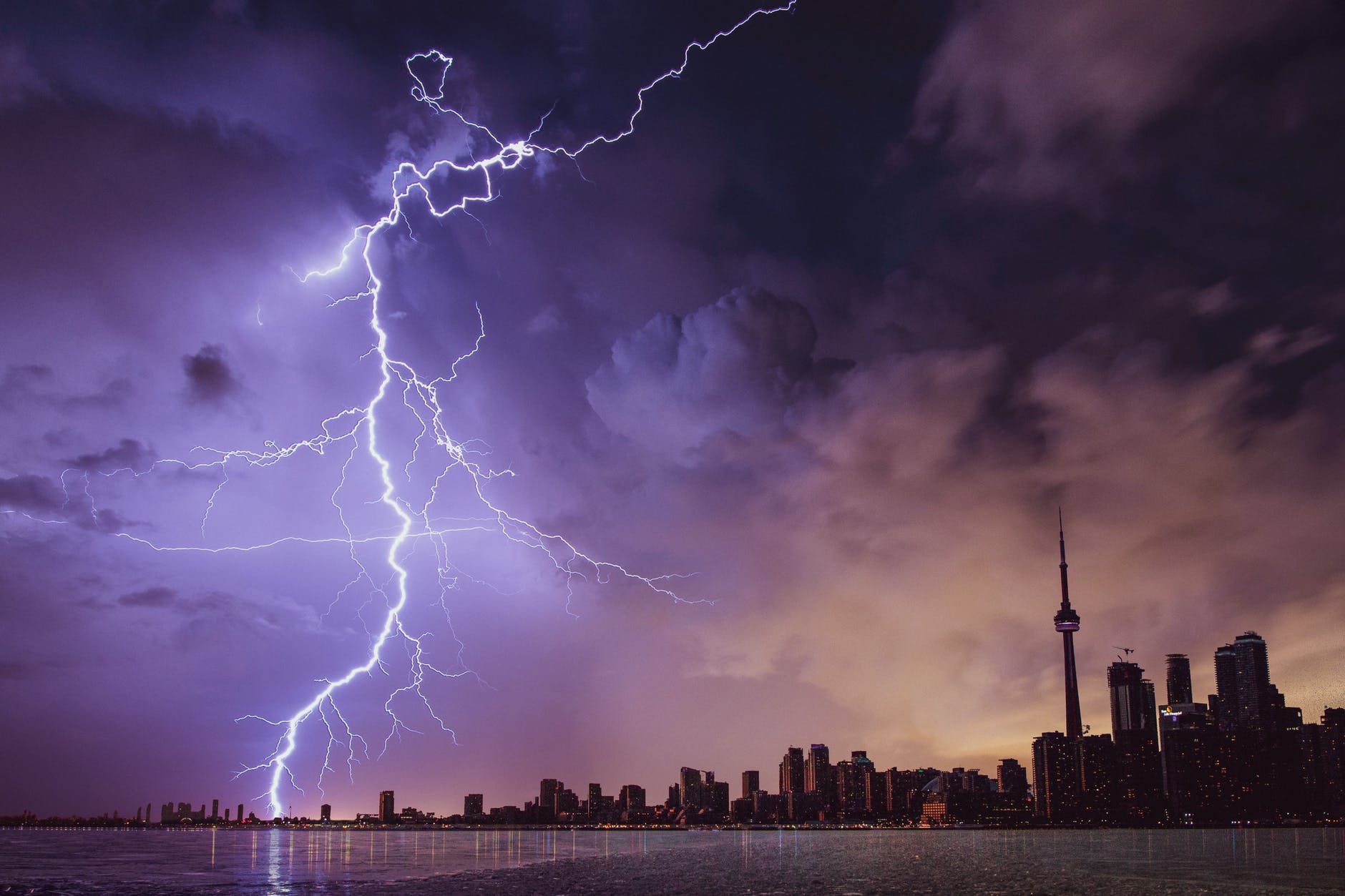
Storms really are unpredictable. They can add an interesting plot twist to a novel, or line to a poem. And they can move from dangerous, unpredictable weather, to rainbows and sunshine. How does this affect your plot?
In my latest book of poetry, Touch My Head Softly, the story involves my lover who had dementia. While I see an “unrelenting grey,” my partner, in his altered state, sees “white lilies surviving frost.”
For me, writing is both. I have been writing since I was eight years old and can’t seem to stop. But I’ve also published three books, derived income from my publishing, which in some circles would make me a professional writer. You just have to write to make it work. It doesn’t have to be brilliant or inspired, it just has to be. You keep going.
You might do many other things besides writing to support yourself, but you still write through it. Stephen King was a high school English teacher. During this time, he wrote his first novel, Tabitha. He kept going despite his busy job.
You are the only one capable of writing your story. It is unique. It belongs to you. Even if you find similarities in the work of other authors who you read, your story is still your story.
I wrote a book of poems about my experiences with my partner dying of Alzheimer’s Disease in his sixties. I even donated part of the proceeds from the book to the Alzheimer’s Association to find a cure.
As writers, we are always looking for the new thing that is going to sprint our writing forward. The inspiration, if you will.
Procrastinating , spending more time thinking about writing than actually writing. I happens to all of us. When I get a block, I just write through it. You may wind up throwing out what you’ve read, but it will get you moving to the writing that you do want to keep.
Writing is a simple process. You sit down at your desk, and you write. That’s it. Whether you feel like it, or not. Even if you’d much rather do just something else. The professional writer keeps going, no matter what.
I wrote a book of poetry about my former partner who died of Alzheimer’s. It was a painful topic for me, but eventually I did it. I’m glad I did. It was recently published by Finishing Line Press. Take a look:
You may have come to think of writing as a solitary, lonely process. And sometimes it is, especially during the pandemic. But writing is a social exchange. We write, often, to publish and put our writing out into the world. Here other people interact with our words, read it, understand it, and sometimes respond.
As a lifelong writer, I do often write in isolation, but I find my best writing comes from sharing it with other writers, or a mentor, and getting their feedback. How do you use speech to further your writing?
Three writers will be doing a live literary reading. Madlynn Haber will be reading from her new memoir for Writers in Progress on May 11 at 7 pm EST. The event is free.
Please join Writers in Progress for an evening online live literature, featuring the work of Writers in Progress writers:
I find myself having writerly thoughts as I am driving, walking, swimming. I pull over and blog on my iPhone if I get a good thought. I used to have a notebook in my car, by my bed stand, but it often disappeared when I needed it. I find I have by IPhone more regularly.
I’ve got a book, Touch My Head Softly, coming out soon from Finishing Line Press. There is always work around a new book, with readings and interviews, but I find myself looking toward my new work eagerly. I haven’t really decided on the next collection, but some new ideas are germinating.
Do you think about your writing as you go through your day? Do you write the thoughts down and write from them later?
Here’s the link to my new book on Finishing Line Press:
Lawrence Ferlinghetti, author of A Coney Island of the Mind, Love in the Days of Rage, and Pictures of the Gone World, died at age 101. He identified as a philosophical anarchist and was part of the beat movement, including Allen Ginsberg and Jack Kerouac. He co-founded City Lights Booksellers & Publishers in San Francisco. He was also a fine artist who painted for many years.
He gained notoriety when he published Allen Ginsberg’s “Howl,” and was indicted for selling obscene material. This led to a famous censorship case, the People v. Ferlinghetti, that forwarded the cause of stopping convictions for selling books. The failed attempt at prosecuting him led him to joke that “the police took over the advertising account and did a much better job.”
He was a rebellious poet, a courageous publisher, and bookseller who would not be intimidated about selling books. He was a major literary figure and force who will be missed.
My new book of poems, Touch My Head Softly, is just out from Finishing Line Press. Check it out:
Have you ever seen a door and wondered what is on the other side?
The idea that you can create by opening a door goes back centuries. A note was found
in a Latin grammar from the monastery of St. Gall in Switzerland in approximately 848
that describes an Irish scribe going outside and writing a poem under trees.
You could open a heart door that would enable you to write about things that you love or your favorite things. The door could be an observation door where you record things you carefully observe. A memory door could lead you to memories, good or bad, that you have saved away in the back of your mind. A wonder door could lead you to things you question, or wonder about. A political door could lead you to write about your concerns in the world.
With the pandemic, the world is in lockdown and there are many closed doors.
We all long for the day with those doors will be open again and life will return to normal.
While we are on lockdown, our minds can wander and explore our thoughts, our wants and our imagination.
My new book, Touch My Head Softly, is now out from Finishing Line Press:
Have you ever seen a door and wondered what is on the other side?
The idea that you can create by opening a door goes back centuries. A note was found
in a Latin grammar from the monastery of St. Gall in Switzerland in approximately 848
that describes an Irish scribe going outside and writing a poem under trees.
You could open a heart door that would enable you to write about things that you love or your favorite things. The door could be an observation door where you record things you carefully observe. A memory door could lead you to memories, good or bad, that you have saved away in the back of your mind. A wonder door could lead you to things you question, or wonder about. A political door could lead you to write about your concerns in the world.
With the pandemic, the world is in lockdown and there are many closed doors.
We all long for the day with those doors will be open again and life will return to normal.
While we are on lockdown, our minds can wander and explore our thoughts, our wants and our imagination.
My new book, Touch My Head Softly, is now out from Finishing Line Press:









 Eileen P. Kennedy Author