Her father, Bronson Alcott, was a Transcendentalist who knew Thoreau and Emerson. He moved here, to Fruitlands Farm, to form a Utopian Society. it failed after 7 months, but it influenced Luisa May, his 10–year–old daughter, to write Little Women and Little Men. What has influenced your writing?
I had a partner who died of Alzheimer’s in his 60’s. It influenced me to writer Touch My Head Softly, due out from Finishing Line Press in January.
It’s always nice to have your work appreciated so I thought I’d share some reviews I’ve received in the last week for my upcoming book, Touch My Head Softly, on Goodreads. , Thank you to everyone who continues to support my writing and I hope to share more positive reviews in the weeks ahead. Have a great day wherever in the world you are.
“In Touch My Head Softly. Eileen P. Kennedy has written an extraordinarily book about the death of a male lover taken in middle age with Alzheimer’s Disease.” —Preston M. Browning, Jr., Director, Wellspring House Writer’s Retreat.
“Many people are now trying to become less helpless, both personally and politically, trying to claim more control over their own lives. One of the ways people most lack control of their own lives is through lacking control over words. Especially written words.” – Peter Elbow
So how do we gain control over our written words? I think it requires work, but it’s rewarding when the result is good. So many problems in the world incapacitate us: the pandemic, pollution, poverty. But learning to use writing as an empowerment tool can be liberating.
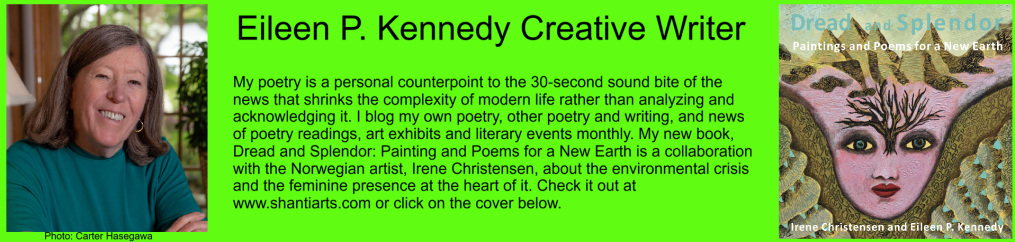
I have a new book of poems coming out with Finishing Line Press. Check it out:
I’ve canoed and hiked in beautiful places all over the Northeast this fall. The nature sustains me. Writing sustains me. I have a new book, Touch My Head Softly, which will be out from Finishing Line Press in early 2021.
“I believe the world is beautiful and that poetry, like bread, is for everyone, and that my veins don’t end in me but in the unanimous struggle for life, love, little things, landscape and bread.”
-Graffiti on a wall in the Mission District of San Francisco
I believe poetry is for everyone. Although many people who read serious print matter and quality fiction do not read poetry, I think that this is their loss. The poetry coming out today is accessible, relevant and enjoyable in concept and sound. Take look at Billy Collins, Natasha Trethaway or even Louise Glück, the 2020 winner of the Nobel Prize in Literature.
MAVEN REACHES MARS: Home Poems and Space Probes in Four Fascicles looks around at a world in crisis and asks, “Where am I?” and “How did I get here?” and by the way, “Who am I?” The answers come wryly, ruefully, sometimes playfully, in poems prompted by the day’s news, by fading family photos, by existential fears and poignant twin grandchildren. Johnson’s poetry reaches out in a conversational style and, like Robert Frost and Emily Dickinson, she writes the reader into the poem. These were the poets her grandmother and mother quoted so often in Kansas and Colorado, decades before Jane moved to Amherst, where Frost and Dickinson are part of the local landscape. But Johnson’s background is beyond fandom. Her early leadings coalesced in the MFA writing program at Goddard College, where she learned from such mentors as Stephen Dobyns, Thomas Lux, Louise Gluck, Robert Hass, and Donald Hall. Jane McPhetres Johnson’s first published book is a life’s work—more than 90 poems all in one place, painstakingly edited and carefully curated over a 50-year pursuit that has largely been a solo flight. Now, with intricate drawings by Portuguese artist Maria Greene, Johnson’s compelling personal and political opus arrives.
Maven is available from Collective Copies/Levellers Press (www.levellerspress.com) in either Amherst or Florence, MA (curbside or mail order) and at Broadside Books (www.broadsidebooks.com) in Northampton, MA and Amherst Books (www.amherstbooks.com) in Amherst, MA
There are things known and there are things unknown, and in between are the doors of perception.” ― Aldous Huxley
For the artist, the world is shaped by perspective. It is that ability to view things from their own unique point of view, yet contextualize this point of view in factual reality. Can everything be defined in a limited world? Can the artist place his/her/their work in the larger framework?
As a writer, I try to contextualize my work in the larger world, but it changes so rapidly. I find I have just gotten my pen around one situation when another arises to contradict the first.
I have been doing phone banks these past few weeks to get out the vote for the presidential election. I try to listen to other people’s perspectives when I speak with them because if there is no dialogue, there is no bridge to unification and understanding between people. If I can’t listen to someone, I can’t convince them of my point of view. The country is so divided that I fear we will never come together again. There are so many signs in front of people’s homes, even in my own community, that advocate different philosophies. How will we all find a common voice after the election?
The dream state is sometimes a source of inspiration for writers, but this is the opposite of reality. But writes thrive on illusion, on an alternate view of what is.
As we pass through daily living, we pass through many―colored lenses that paint our writing with its own view. Yet how do we bring our view back to the world view, so everyone can relate?
My book, Touch My Head Softly, was recommended by Brilliant Light Publishing. It is my perspective on Alzheimer’s Disease. Take a look:
Madlynn Haber lives in Northampton, Massachusetts. Her work appears in Letters to Fathers from Daughters, Anchor Magazine, Exit 13 Magazine and onwebsites including The Jewish Writing Project, Hevria, Right Hand Pointing, Mothers Always Write, Random Sample, Club Plum Literary Journal, Ariel Chart International Literary Journal, The Sunlight Press, Sparks of Calliope and Adelaide Literary Magazine. You can view her work at www.madlynnwrites.com
Contribute to her efforts to raise money for immigrants at the Center for New Americans at:



 Eileen P. Kennedy Author