
Meditating and Writing

Photo by Prasanth Inturi on Pexels.com

Many writers are also meditators. Some even write about the relationship between writing and mediation. I am a meditator and a writer. I meditate in the morning and write in the morning. I also practice yoga. To me, these are all intertwined.

The U.S. alone has an estimated 36 million yoga practitioners. It has adapted to local socio-political and cultural norms world over so much so that it can hardly be called an Indian custom. Yoga originated in India. The system of yoga has physical, mental, and emotional dimensions in addition to spiritual underpinnings. But yoga is not a religion. It has no dogma. But the practice for me is essential to my writing and brings me to a place where I can write truth.

Meditation helps improve focus. Something essential for the good writer. I began meditating years ago with a meditation method popular at that time, Transcendental Meditation. Maharishi Mahesh Yogi developed this mantric method of meditation in the 50’s in India, and it spread widely throughout the world. For me, it was a good place to learn the technique, but my meditation practice evolved when I combined meditation with yoga, especially Kundalini. Kundalini is a spiritual energy or life force located at the base of the spine, conceptualized as a coiled serpent. It didn’t matter which type of meditation I was using, as long as it focused my mind and enabled me to write from that place.

Meditation provides a safe space to be. Meditation slows the world down to make room for creative thought and exploration. It’s an ideal practice for the writer or artist. I meditated every day when I worked on my latest manuscript, Dread and Splendor: Paintings and Poems for a New Earth.

Have you had experiences with writing and meditation?

I will be taking a hiatus for March, as I travel through Costa Rica. Look for me again in April.
Write a Strong Opening to Bring Your Reader In

Photo by Andrew Neel on Pexels.com

Writing an opening, a foreword to a book, a first line that will encourage your reader to continue is a challenge.

The tone for a trial is set by the lawyer’s opening statement. It’s the first opportunity to make an impression, to frame the narrative. In your writing, your introduction serves the same purpose.

Start with a strong statement. Hook your reader with a provocative statement. “Call me Ismael” brings you right into Moby Dick. It’s an invitation you can’t refuse.

Lawyers build their cases on evidence. They introduce facts, exhibits, testimonies to support their opening statement. Your introduction should also be grounded in facts.

Lawyers question witnesses to strengthen their case and counter opposing arguments. As a writer, you should think about and address counterarguments to your opening, including opposing views. Provide a thoughtful counter-argument. Consider all sides of the issue and enhance your reliability.

In all of these ways you will have an opening that will encourage people to continue reading.

In the case of a poetry collection, like Dread and Splendor: Paintings and Poems for a New Earth, the artist, Irene Christensen and I, put the strongest paintings and poems up front. There are 27 paintings and poems in a 60-page manuscript. We began with poems that editors had chosen for publication and with paintings that had been curated for international shows.

I’ll be blogging on Thursdays, following the progress of our manuscript, Dread and Splendor: Paintings and Poems for a New Earth. And writing about the writer’s process. Follow me here.

Friendship and Artists

I recently was given a book by a writer friend called A Friend Sails in on a Poem, by Molly Peacock. It is a book about two friends who are poets and it’s dedicated to “all friends who make art together”. It put me in mind of all of the friendships I have made of other artists and how easy it is to take these relationships for granted.

This book celebrates the friendship of Molly and her poet friend of 46 years, Phillis Levin. According to the book “they have read and discussed nearly every poem they’ve written, creating an unparalleled friendship.” It puts me in mind of all the years I have sat in writing groups reading to my writer friends and seeking their support in my endeavors.

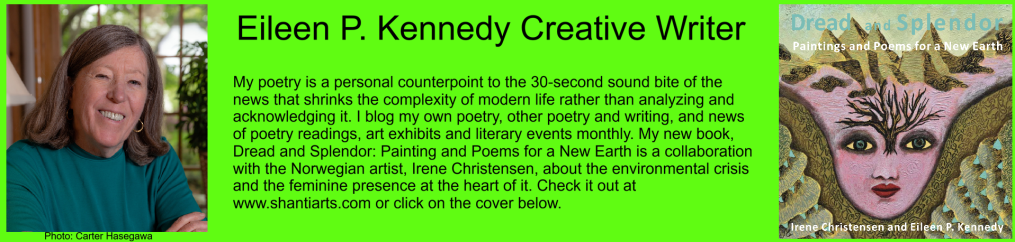
The past two years I have been collaborating with the Norwegian artist, Irene Christensen, pictured on the left above. We met at the Julia and David White Artist Colony in Costa Rica years ago and it was our mutual love of nature and art through the years that eventually led to our collection of eco-poetry and art called Dread and Splendor: Paintings and Poems for a New Earth.

I guess when one artist collaborates with another, it creates an understanding of the other’s artists’ work that wouldn’t have been possible otherwise. Irene created a series of paintings about women at the heart of the environmental movement. I responded to these evocative paintings in the best way I know, through poetry. 

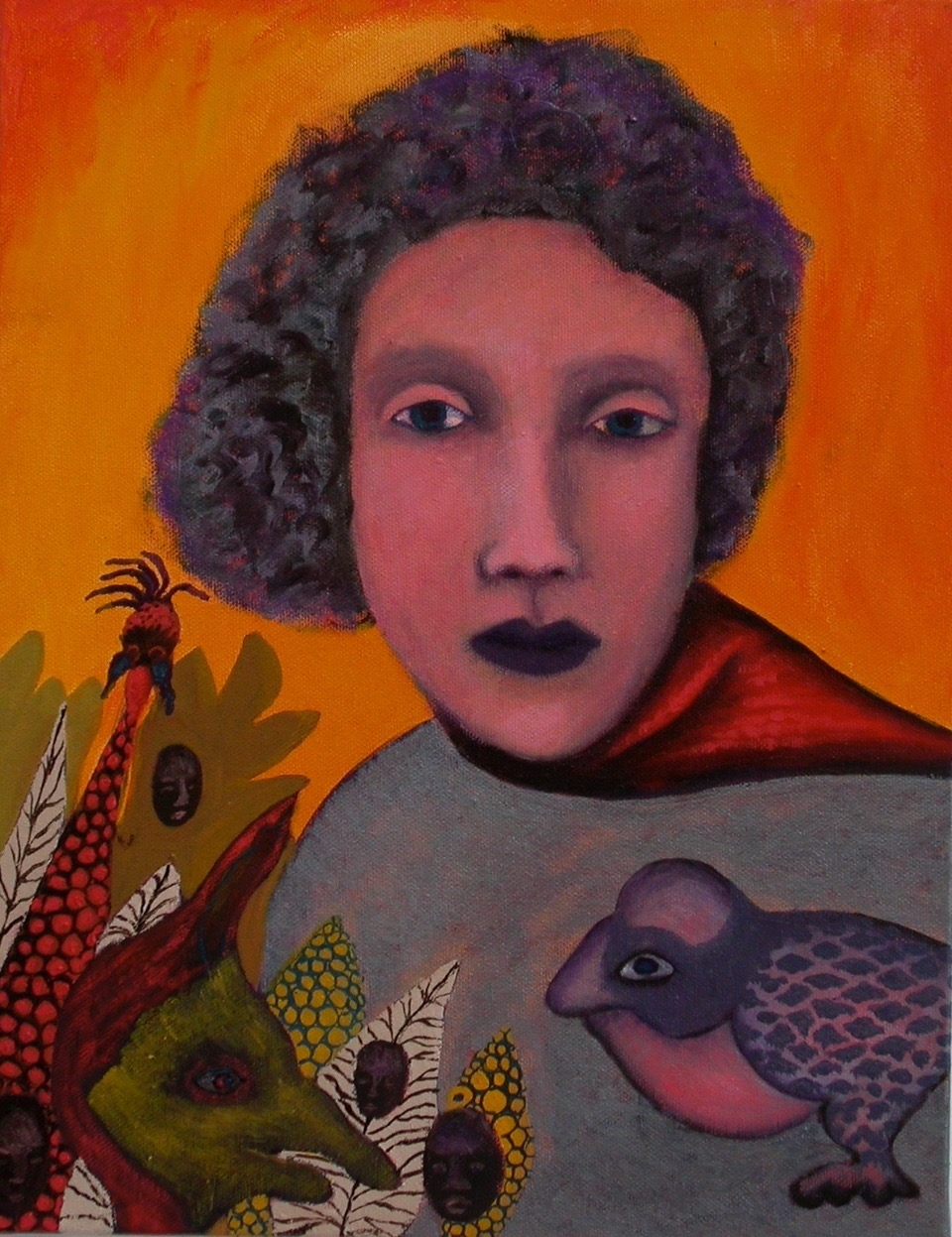
           Yesterday. Oil, 16” x 12” by Irene Christensen

I responded to Yesterday with a poem called “She Occupies Time,” which begins “no quiet merging with the azure, but an orange  sky, the earth bizarre with diasporic life.” The combination of painting and poem merge to become something new. A way of communicating in art that transcends painting or poem alone.

Irene started exhibiting her paintings with the poems I had written for them. Perilous Journey at the Galleries of the Interchurch Center in New York City. Queen of the Woods was exhibited with poem and painting at the Voices of the Earth Exhibition in Galleri Schaeffers Gate 5, Oslo,Norway. The painting and poem were sold together as that’s what the buyer wanted, the experience of having both the poem and painting together in his home.

The experience of collaborating and supporting each other as writers and artists is an invaluable part of the process. What has your interpersonal journey been like as a writer?

I will be blogging on Thursdays. Follow me here.

Congratulating Yourself on Finishing a Piece of Writing

Photo by Skylar Kang on Pexels.com

As writers, we often feel that we don’t do enough. We don’t put enough hours into our writing,

we don’t do enough research before writing, and we don’t publish enough. When you finish a

piece of writing, give yourself a pat on the back: You finished a piece of creative writing—

something many attempt, but not quite as many achieve. I recently finished a manuscript called

Dread and Splendor: Paintings and Poems for a New Earth. I collaborated on it with the

Norwegian Artist, Irene Christensen. It’s a collection about the climate crisis and women at the

heart of it. I feel good about completing it.

Some writers consider the worth of their writing in the published pieces, but others don’t even

attempt to publish. The reward for them is in the process. You can share your writing at an

open-mic reading. You can post it online or bring it to an in-person writing group for

constructive critique. You can send it to a friend.

You can send it to a literary journal or an agent for possible publication, but that’s a topic for

another blog. As writers, we need to acknowledge our accomplishments for ourselves.

I’ll be blogging Thursdays about the writing process. Follow me here.

The Journey of an Eco-poetry Manuscript

Dread and Splendor: Paintings and Poems for a New Earth

Manuscripts are not easy to put together, especially when they’re a collaboration. I have a new manuscript of eco-poetry that I am collaborating on with the Norwegian artists, Irene Christensen. I would like to write about the different stages of developing and publishing a manuscript.

The project started one winter at an artist colony, The Julia and David White Artist Colony, that sits on a naturally spectacular 17-acre rain forest, is in Costa Rica.  We both shared a love of this beautiful country. I was drawn to Irene’s evocative full-color paintings. Irene expressed admiration for my poetry.  I gave Irene a copy of my second poetry collection, Touch My Head Softly (Finishing Line Press, 2021) and she gave me her painting, “Volcano Flower.”  This interaction started a conversation that over a two-year period developed into the manuscript, Dread and  Splendor: Paintings and Poems for a New Planet.

The current collection comes from our common interest in natural beauty, the complex relationship between living things and the atmosphere, stopping exploitation of the earth that spans geographical and historical borders, and the feminine care at the center of environmentalism.

Irene worked on a series of art pieces  about women at the heart of the environmental justice movement.   I observed the creation of many of these remarkable paintings and wrote a series of ekphrastic poems, or written responses, to them.  We nurtured our creativity and friendship through this process.

Irene’s paintings unfold as the world heats up and becomes more and more unlivable. She creates images through the eyes of children,  mythical characters like trolls and goddesses, and the lenses of women witnessing the dying globe.  I reinforce this journey in words, giving verbal credence to Irene’s vision, and mine, of the future.

I hope to blog about our journey as the manuscript goes through different stages and if we can even find a publisher. Follow me here on Thursdays to continue this journey.

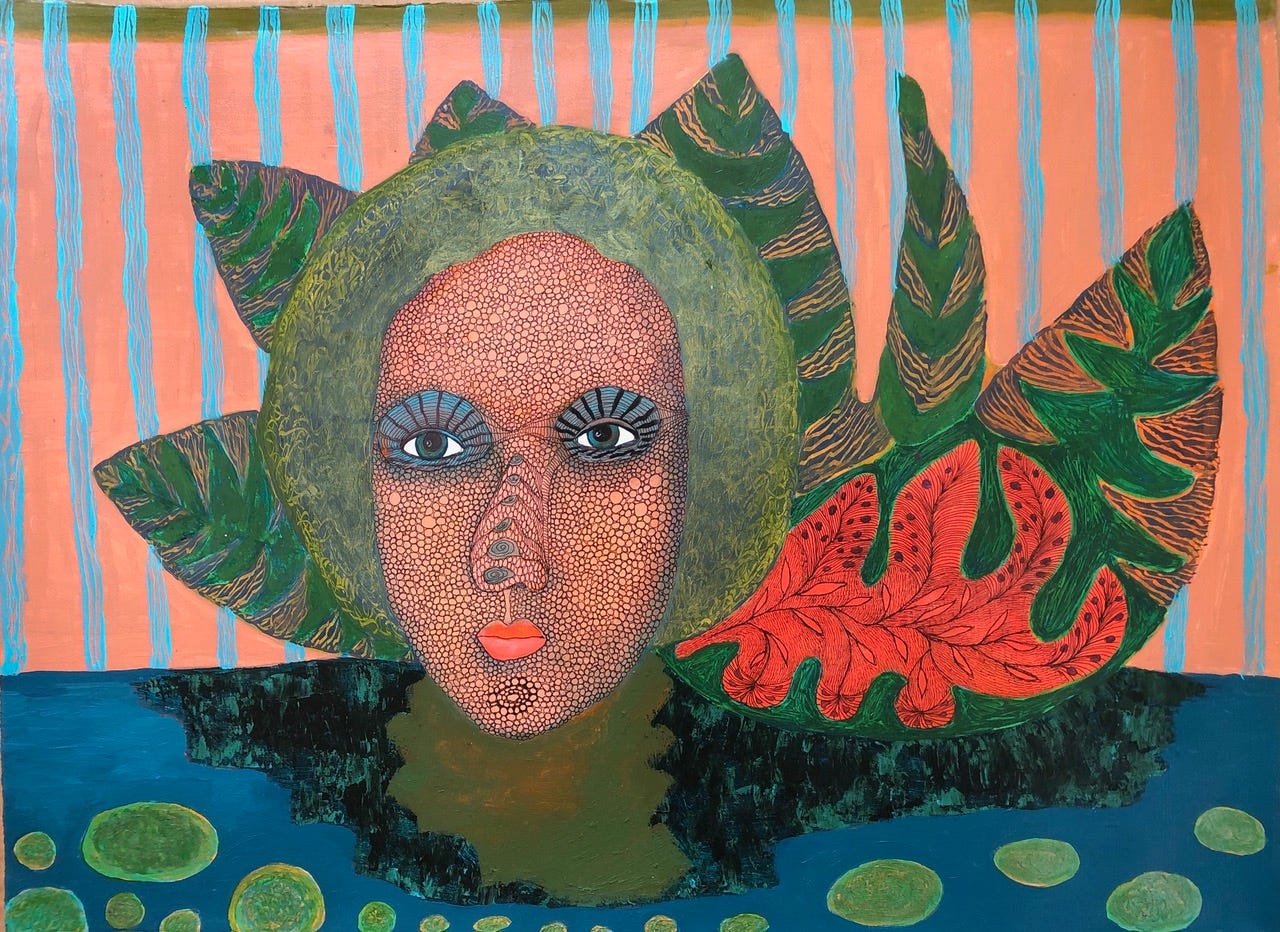
I Feel Close to Nature Too. Acrylic, 22” x 30” by Irene Christensen