We have to read to write. It’s that simple. If you want to write a fiction, read good novels. If you want to write poetry, read good poetry.
Reading serves as a form of mentorship, especially if we read as writers, and read good writing. Reading provides rich fertilizer for your own writing.
Writers need to read what they like, what they find stimulating, what other people find stimulating. This will improve a writers writing.
Reading in our genre, and outside of our genre, will give us an idea of the diverse compositional structures that exist and are available for us to use, and use well. For an ode’s structure, read “Ode to a Grecian Urn,” by Keats. For historical fiction, try Real Estate by Kathryn Holzman (Propertius Press, 2020.) For grief or illness poetry, try Touch My Head Softly (Finishing Line Press, 2021.) For a memoir try, Hillbilly Elegy: A Memoir of a Family and Culture in Crisis (Harper, 2016.)
I will be blogging on Thursdays, with announcements, as they come up, on Tuesdays.
“Hold fast to dreams for when dreams go Life is a barren field frozen with snow.”
–Langston Hughes
I live in the Northeastern United States and we are leaving winter behind and moving into spring. Green things are starting to pop out of the ground and the trees have small bursts that will be leaves. As a poet, I like to take out what I’ve written over the winter and see what can be used in a manuscript or for a journal submission. So I hold onto my dreams, my writing, and figure out what is worth publishing.
Some writers, like Mary Gordon, write pen on paper. I need a computer. But I need to revisit the joy of writing periodically. I also do this after a long winter. Spring is the time for renewal, to look back at the past, find what’s good, and move forward. It’s a good time to put the best of your work into manuscript form.
I will continue to blog on Thursdays, with announcements as they come up, on Tuesdays.
Beautiful, precious things make life worth living, especially in these difficult times. Poetry is a celebration of the beauty, and sometimes lack of it in life.
It’s important to make beauty in the world, especially when war and violence are a threat. I make beauty, as many poets do, in my poetry. This beauty makes life worth living, even in depressing times. In fact, I try to write through the despair.
And it’s important to remember to be grateful for this beauty. Everyday, in my meditation, I find something, even on bad days, to be grateful for, i.e. the sounds of the spring peepers at my local pond, the small green sprouts of spring, etc. I’m sure you can add to this list.
I will continue to blog on Thursdays, with announcements, as they come along, on Tuesdays.
When you finish a manuscript, there is usually a down time for reflection, but then, as a writer, you need to start on a new project. I find this phase challenging because I often have many ideas percolating, but don’t know which one to choose to pursue. It’s a commitment.
There’s not enough time to pursue all my ideas, so the issue is which projects to pursue and which to pass by, maybe forever. So I ask myself, is this the right concept for a poem, narrative for a story?
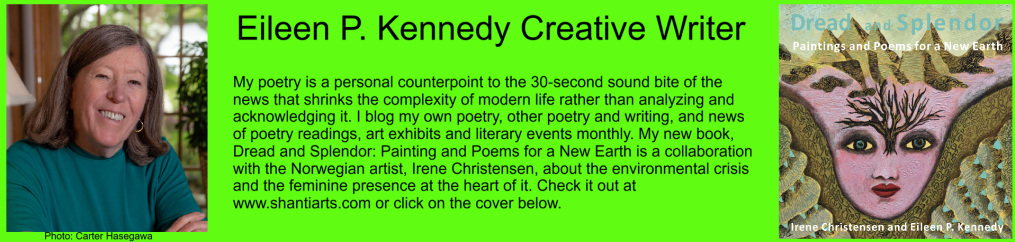
There’s a project that’s right for you, and only you can find it. I recently published a book of poetry and now I am in search of a project. Check out my book at:
I woke up last night in the middle of the night and couldn’t get back to sleep, war on my mind. The new poem I had written that day needed a title. I got out of bed and added the title to the poem.
This act of writing can be a savior in these dark times. The writing is a form of sanity for me. If I am writing about current events or not, it is a way of keeping myself focussed on something positive.
My creative visualizations are on world peace these days. My creative writing takes me anywhere it leads me.
I will continue to blog on Thursdays, with announcements on Tuesdays.
I so appreciate the thoughtful review Emily-Jane Hills Oxford gave my book in Reader’s Favorites:
“This is a passionate and engaging read, one that will strike a chord with many, as Alzheimer’s, like cancer, has affected most families in one way or another. It’s a powerful tribute to who have and are suffering and those who care. Stunningly, sublimely beautiful.”
I love the quiet, the writerlyness of the whole thing. But how does this affect my writing? I wrote a collection of poems about my partner who died of Alzheimer’s. We had spent a lot of time in Mexico, so this landscape came into my poems:
“When I think of Oaxaco
I remember the Zocolo
where they sold pipa del agua
and chocolate dripping from paper cups.”
The setting just naturally came into the poem. Does this happen with you?