Starting the Writing Process

Photo by Photo By: Kaboompics.com on Pexels.com

Whether you’ve had six books published or you are a new writer, getting started can be a challenge. Writing is a process, not merely a product. The quality of your writing will be reflected in the thought and time you put into it.

Having a deadline can be helpful. If you have an editor waiting for your final draft or you have an assignment due, this is a motivation. If you don’t, you can set one for yourself. I often do.

Planning ahead is a good place to start. Sn outline is even better. You don’t have to actually write, you can just think about what you want to say and plan ahead. When you do sit down to it, you’re that much ahead. Then schedule a few writing sessions. That way if you’re not feeling like it, or if you want some revising time, you can return to it later. I rarely finish a piece in one sitting.

Topic and audience are often interrelated. Think about what you want to say to your audience and how that informs your topic. Ask yourself who the audience is, Why is your audience interested in this topic and what do they already know, if anything, about it. What of you think your audience would/should gain from your text?

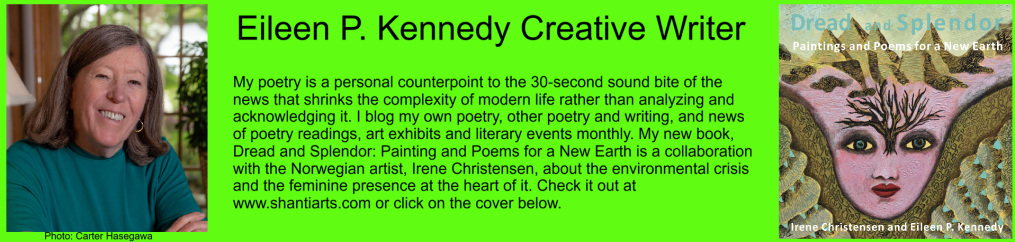
Think about the purpose of your writing. Why are you writing the piece My most recent book, a collaboration with the Norwegian artist, Irene Christensen, was inspired by her paintings about women at the heart of the environmental movement. It’s called Dread and Splendor: Paintings and Poems for a New Earth. I wanted to respond poetically to Irene’s work, but I also wanted this to raise awareness of the environmental crisis.

My new book will be out in early 2026 from Shanti Arts. I will keep you apprised of the publishing process on it. Follow me here monthly.

Titles

Photo by Mark Neal on Pexels.com

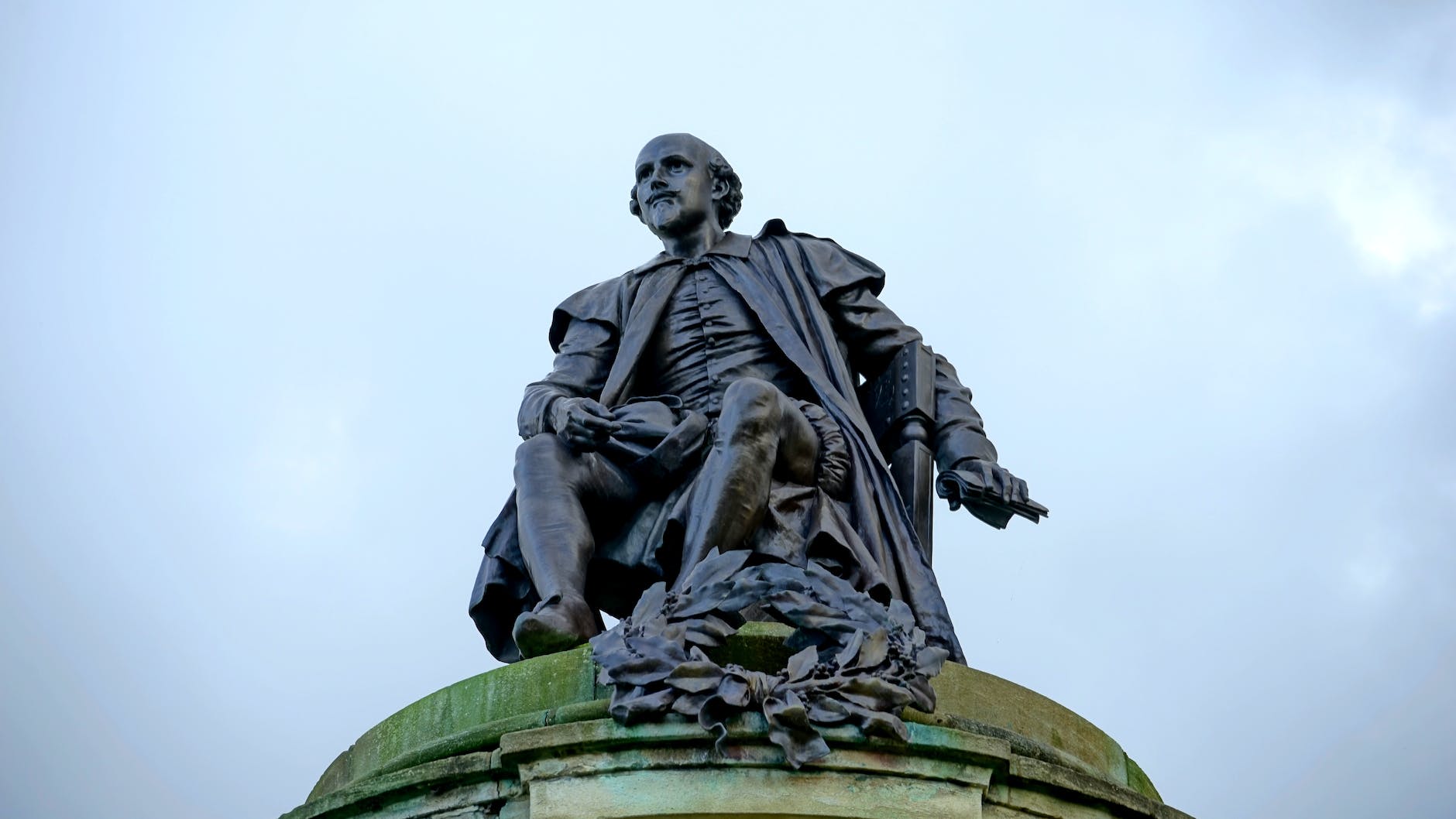
Titles of books, short stories, poems, are very important.

Corporations spend millions to find the name of a product. Thought should be put into how you title your creative product.

Let’s discuss book titles. The first thing anyone hears about is the title of your book. It even precedes the cover. Once the artist knows what the title is, he/she can work on the visual concept. Think about what you will call your book. Here are some things to think about:

.It should give an idea of what the book is about.

.It should be easy to say.

.It should be memorable.

.It should grab your attention.

When we were deciding on a title for our manuscript, Dread and Splendor: Paintings and Poems for a New Earth, we tried out a lot of titles. The first one was “Dreadful Splendor” from a W.B. Yeats poem. This was taken by a previous book, so we changed it to “Dread and Splendor.” We thought this encompassed the “splendor” of the art and poems and the “dread” of the environmental crisis. Then we decided this didn’t really tell what the book was about and we added the subtitle “Paintings and Poems.” At first we had “Paintings and Poems for a New Planet.” But then we thought it sounded too much like speculative or science fiction. So it became “Dread and Splendor: Paintings and Poems for a New Earth.”

The same is true of a short story, poem or play title. Editors look at hundreds of poems and short stories.

If you follow the guidelines above, you’ll draw attention to your piece from the beginning and have less change of being passed over.

Sometimes for titles a phrase can be used from the manuscript can be just the right thing. If you have a concept that is long, write it down and then edit it.

Try discussing your book using the title and seeing if people understand and appreciate what you’re saying. See if they ask questions and are interested in the title and what you have to say.

Choosing the perfect title is mostly about trial and error. If you try out a number of titles, the best one becomes clear.

I will be blogging monthly, taking about the production of Dread and Splendor: Paintings and Poems for a New Planet through publication and beyond. Follow me here.

Writing in a Foreign Country

Photo by Kevin Malik on Pexels.com

If you are a writer, you write. Even if you’re traveling or just put down for awhile in a new place. I find traveling stimulating for my imagination and a natural time to write, even if it’s just in a travel journal.

For about the past twenty years, I have been spending winter in Costa Rica, where mostly I writeThe change of location seems to effect my writing in a positive way. Travel brings new experiences and ideas to you that will show up in your writing.

The travel can be anywhere: the next town to another country. I just don’t like winters in the Northeast, where I normally live, so I like traveling in warmer climbs in the winter months. I’ve traveled in the winter in Mexico too. I mostly write while I’m here. i devised the manuscript for my upcoming book: Dread and Splendor: Paintings and Poems for a New Earth here.

I find the change of scene helps my writing in several ways. First of all, whether I’m in a hotel or temporary apartment, I don’t worry about cleaning or answering mail (which I have held.) I focus more on my writing. Also, you don’t tend to be on the phone with telemarketers or even friends. 

Then there is just the stimulation of being someplace different, with a different language, culture, sights. This may lead to a whole opening up of your writing to new topics.

You can add new language to your writing. A noun or two in Italian or Spanish can add to the authenticity of your poem or story. But be careful about using too much that a non-Spanish or non-Italian speaker may find confusing. You can offer your reader context cues and nonverbal communication to help understanding. You can also italicize the foreign word to distinguish it from the English.

You can also set your next piece in the country your visiting. I’ve often written poems about Costa Rica. The sights and smells of the country will permeate your writing. It’s a much better way of learning about it then researching online or in a library. Talk to as many locals as possible. Introduce yourself as a writer and explain that you are working on a story set in that country. This will help open up people to answer your questions.

Read other books set in that country and google it. Read blogs, articles, travel articles, news. Learn as much as you can about the country.

Finally, talk to your accountant. You may be able to write off your travels to your writing business. I am publishing a book, Dread and Splendor: Paintings and Poems for a New Earth early next year with Shanti Arts. It’s a book that was hatched by myself and an artist, Irene Christensen, on one of my visits to Costa Rica. The book, which has some poems and paintings about Costa Rica, would not have existed unless I had made that trip to Costa Rica.

I will be blogging monthly about the writing process and my new book. Follow me here on Thursdays.

On Using the Pause in Your Writing

Photo by Ekaterina Pashkevich on Pexels.com

“How much better it seems now, than when it is finally done. How hungrily one waits to feel the bright lure seized, the old hook bitten.

–Dana Gioia

Writers have been using “the pause” in their writing for a long time. This is a space between writing sessions where the writer breaks off before the piece is finished, and think about the piece in between. Many famous artists used this method from Hemingway to Beethoven. For creatives, it’s a way of keeping going when you know something is unfinished.

This “pause” taps directly into the creative process. Unfinished tasks stay in the psyche and urge the artist to be finished. Hemingway liked to stop in the middle of a sentence. Then he would think about the passage he had left behind until he was able to return to his work.

Artists don’t finish great works in one sitting anyway. Picasso would start multiple paintings at once and pause before each one was finished. Maya Angelou would stop mid-paragraph, if she felt it wasn’t going quite right. Pausing creates a discomfort for the artist. The artist is uncomfortable when the piece is left unfinished and wants to get back to it, maybe after many pauses, and finish it. The pull of the unfinished will bring the artist back to where he/she left off.

The pause is not complicated. It’s not something that requires hours of training or discipline. It’s just the call of the unfinished; the itch that needs to be scratched; the natural calling back to the page.

When I wrote my latest manuscript, Dread and Splendor: Paintings and Poems for a New Earth, it took me two years. It was my first collaborative effort with the Norwegian artist, Irene Christensen. We started the project in Costa Rica, where we had casitas close to each other in an artists colony, but later there were many pauses as we communicated across continents. She met me at my house in Massachusetts and I met her several times in New York City. But most of the reconnecting was done via internet or phone.

The manuscript has now been accepted by two publishers and there will be pauses and reconnecting again as we move forward with our new publisher, Shanti Arts. I will blog on Thursdays. Follow me here.

I’m Delighted The Orange & Bee Is Publishing My Twin Poem “Fairy Tale of Eternal Economic Growth”

I’m delighted to have my poem, “Fairy Tale of Eternal Economic Growth” published in the September 27, 2024 issue of The Orange and Bee. I’ve attached a link to it below if you want to read it.


The submission is a twin poem, which means the two columns can be read down or across.I drew on the Norse Folk Tales of Greta Thunberg’s Scandinavian heritage.  Odin had two wolves, Geri and Freki.  Geri was interpreted as the greedy one and Freki the avaricious one.  I think wolves are a good symbols of the corporate greed that Thunberg argues against. The visual they use with the poem is Greta Thunberg’s photo as a child.

Photo by Balpreet Singh on Pexels.com

The Orange & Bee publishes original and contemporary short stories, poems, and essays that explore, expand on, and subvert the rich traditions of international folklore, with a strong focus on fairy tales (though they also sometimes dabble in other forms of folklore, such as fables, myths, and legends). They also publish traditional tales accompanied by annotations, discussion questions, and writing prompts. Their real mission is to build a community—a virtual salon—around shared passion for fairy tales.

See the poem and photo of Greta Thunberg here:

https://theorangebee.substack.com/p/4523ca2d-ab6b-4812-b67e-7a157178cdeb

I am writing much eco-poetry these days, about the environmental crisis. I compiled a manuscript of poems and paintings, with the Norwegian artist, Irene Christensen, called Dread and Splendor: Paintings and Poems for a New Earth. It’s a book about women at the heart of the environmental movement. I will blog on Thursdays. Follow me here.

Creativity and Overcoming the Blank Page

Photo by Pixabay on Pexels.com

Have you ever thought “I have a book inside me, waiting to be written”? As an aspiring author myself, I know that yearning all too well. I spent a lot of time staring hopelessly at blank pages, willing the words to flow but finding only frustration. My dream of writing a book felt out of reach. You may be creative, but if you’re staring at a blank page, it doesn’t matter.

People who are creative are happier, healthier, and less lonely. A published poem can lead to a reading, a painting to an exhibit, a song to a concert. I recently wrote an ekphrastic poem recently to my friend’s painting and she sold it, with the poem. All of these things put us, and our art, out into the world to see and be seen and to interact.

A creative ability is a skill to use our imagination to solve a problem. We may feel stuck with a problem, but if we read up on how other people have solved this, or ask a friend how they solved this, we are using creativity to problem-solve.

You don’t have to be an artist to exercise your creative ability. You can use this skill to fulfill dreams, problem solve, and improve communication skills.

Follow me here. ‘ll be blogging on Thursdays. Good luck with your creative endeavors.

Why Are We So Insecure About Our Writing?

The shadow of the dome of pleasure
Floated midway on the waves;
Where was heard the mingled measure
From the fountain and the caves.

--Samuel Taylor Coleridge (1772-1834)

Coleridge wrote these lines in 1797. Just listen to the rhythm and music in the lines. Coleridge did not publish “Kubla Khan” until 1816, at Lord Byron’s insistence. Coleridge worried about the irregular meter and that sections of the poem were not coherent. Yet, it is considered one of the best poems published in the English Language.

In a sense, that’s fair enough. The poem does not hold to traditional poetic unity in the way other Coleridge work does: his long narrative poems “The Rime of the Ancient Mariner” and “Christabel,” for example, and “Frost at Midnight,” his hymn to fatherhood. The poem began in a drug-induced dream.

Photo by Tyler Lastovich on Pexels.com

So how many of us writers doubt the worth of our writing? Bertrand Russell, a famous writer in his own rite, had three tips for insecure writers:

Learn to recognize your writing insecurities and admit to their existence. You can’t address a problem if you pretend it’s not there. Look at your particular insecurities and recognize them. That way you’ll be prepared when insecurity strikes.

The second is to recognize that you’re not alone in your insecurities. All writers feel insecure about their writing one time or another. If you’re insecure about grammar, work on grammar. Remember no one writes a text right the first time.

The third tip is to let go of any concept of perfectionism that you have. If you finish a text and feel you can do better, it just means that you’re developing some judgmental ability. Being insecure with your writing is part of a writer’s life.

I recently finished a manuscript called Dread and Splendor: Paintings and Poems for a New Earth, with the Norwegian artist, Irene Christensen. Every time I submit a manuscript to a publisher, even though I’ve published three books, my insecurities come to play. The worst that can happen is that it will be rejected and I will submit it elsewhere.

Follow me here on Thursdays as I write about the writing process and the journey of my manuscript.

A Career As a Poet

Photo by Mike B on Pexels.com

There’s no money and little interest in poetry. One of the reasons for lack of interest in poetry is the way it was taught in school. You were taught to find a meaning, which is work, like cracking open a walnut and digging out the meat. Sometimes poets add to their own problems by making their poems difficult to understand. A poet has to learn to connect with the audience.

So why do we become poets?

We become poets because we love poetry. When I read a good poem, it totally nourishes me. When I write a good poem, there’s no better feeling. Louise Nevelson, the sculptor, said “I’d rather work twenty-four hours a day in my studio and come in here and fall down on the bed than do anything.”

Seamus Heaney, the Nobel-Prize winning poet said “The aim of the poet and the poetry is finally to be of service to ply the effort of at the individual work into the larger work of the community as a whole.” Here he says the poet makes a contribution to society as a whole. Though it’s amazing to write a poem that pleases the author, to write something that touches the reader is about as good as it gets.

Letting the poem become part of your experience is invaluable. If you read a poem about a robin that touches you, it re-freshens the world. The next time you take a walk and see a robin, you will notice it.

Poets read other poets. This teaches us to write the kind of poems we like to read.

Writing poems can be exhilarating. Joy Harjo the Poet Laureate, says “I don’t know when the first poem was, where it came from, or exactly how. I just know how much I needed it…I was in the dark and decided to investigate the dark to find the light.” Writing poetry is just that, finding the light in the dark.

I collaborated on an eco-poetry manuscript with the Norwegian Artist, Irene Christensen called Dread and Splendor: Paintings and Poems for a New Earth. It’s currently out with publishers being considered for publication.

I’ll be blogging on Thursdays. Follow me here. Let me know about your own writing experiences and I’ll blog about the journey of my eco-poetry manuscript.

Friendship and Artists

I recently was given a book by a writer friend called A Friend Sails in on a Poem, by Molly Peacock. It is a book about two friends who are poets and it’s dedicated to “all friends who make art together”. It put me in mind of all of the friendships I have made of other artists and how easy it is to take these relationships for granted.

This book celebrates the friendship of Molly and her poet friend of 46 years, Phillis Levin. According to the book “they have read and discussed nearly every poem they’ve written, creating an unparalleled friendship.” It puts me in mind of all the years I have sat in writing groups reading to my writer friends and seeking their support in my endeavors.

The past two years I have been collaborating with the Norwegian artist, Irene Christensen, pictured on the left above. We met at the Julia and David White Artist Colony in Costa Rica years ago and it was our mutual love of nature and art through the years that eventually led to our collection of eco-poetry and art called Dread and Splendor: Paintings and Poems for a New Earth.

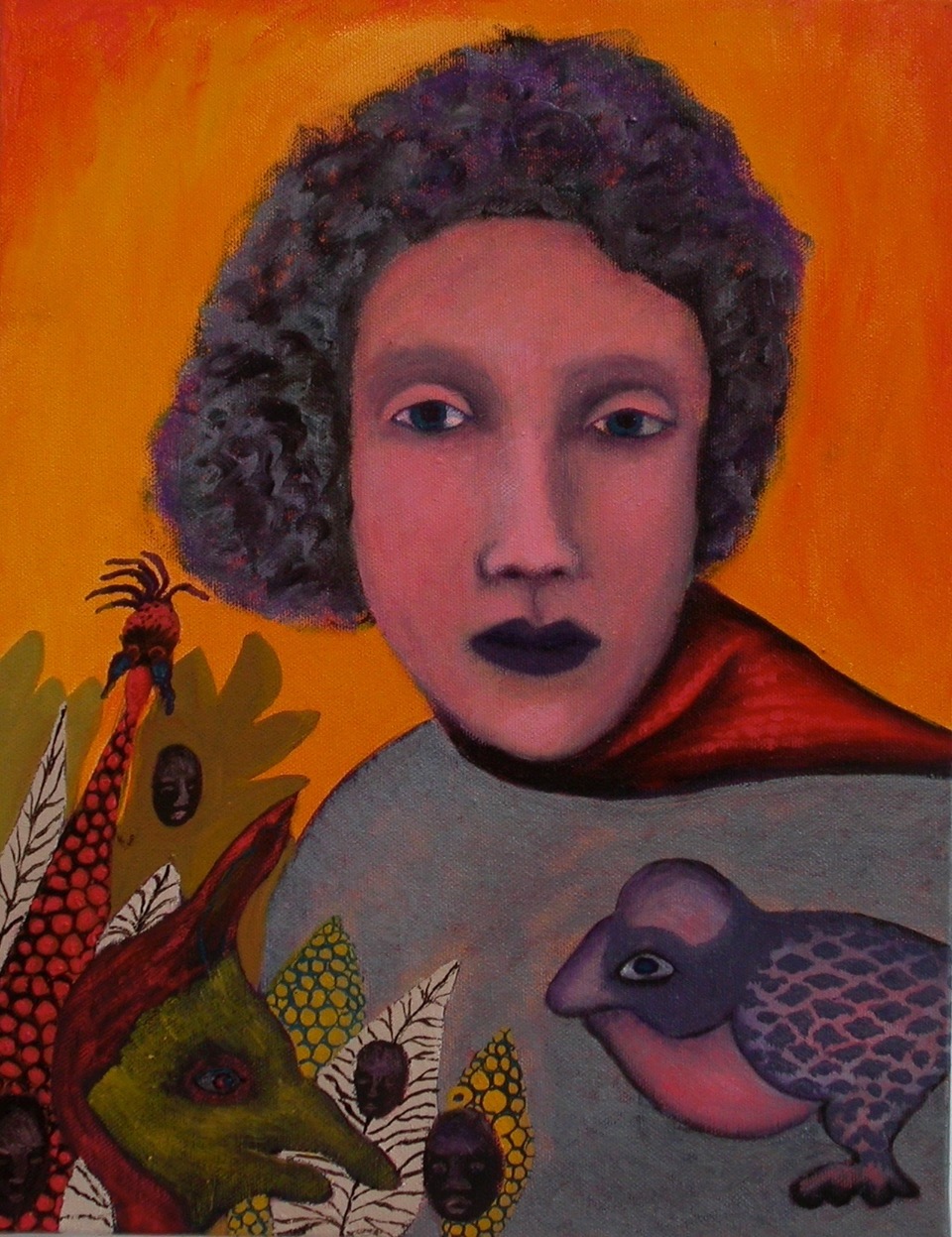
I guess when one artist collaborates with another, it creates an understanding of the other’s artists’ work that wouldn’t have been possible otherwise. Irene created a series of paintings about women at the heart of the environmental movement. I responded to these evocative paintings in the best way I know, through poetry. 

           Yesterday. Oil, 16” x 12” by Irene Christensen

I responded to Yesterday with a poem called “She Occupies Time,” which begins “no quiet merging with the azure, but an orange  sky, the earth bizarre with diasporic life.” The combination of painting and poem merge to become something new. A way of communicating in art that transcends painting or poem alone.

Irene started exhibiting her paintings with the poems I had written for them. Perilous Journey at the Galleries of the Interchurch Center in New York City. Queen of the Woods was exhibited with poem and painting at the Voices of the Earth Exhibition in Galleri Schaeffers Gate 5, Oslo,Norway. The painting and poem were sold together as that’s what the buyer wanted, the experience of having both the poem and painting together in his home.

The experience of collaborating and supporting each other as writers and artists is an invaluable part of the process. What has your interpersonal journey been like as a writer?

I will be blogging on Thursdays. Follow me here.

Enjoying the Process, As Well as the Product

Photo by Porapak Apichodilok on Pexels.com

“What keeps life fascinating is the constant creativity of the soul.” —Deepak Chopra

In the pursuit of success, we often focus on the end result. In so doing, we neglect interest in the journey because we want to get there as soon as possible or we lose the desire to even reach the destination.

Many artists focus on the final product, but the secret is in enjoying the process of creation

The process itself is a reward. The creative journey should interest you far more than reaching the destination. I am currently working on a manuscript, Dread and Splendor: Paintings and Poems for a New Earth, with the Norwegian artist, Irene Christensen.

We forget forget to enjoy the journey, and in effect, we lose our desire to even reach the destination.Sylvia Plath said, “The worst enemy to creativity is self-doubt.

Creativity holds great significance when it comes to connecting with our soul or authentic self.

By tuning into that creative fire that burns within, we can connect more powerfully with the soul. For some people, creativity can even be more affective at this than meditation.

When we make room for creativity in our lives and activate our creative muscles, it can be transformative. It can strengthen our intuition, release stagnant energy, and align with our larger project, like writing a book or composing a song.

I will be blogging on Thursdays. Follow me here for the journey of the manuscript, Dread and Splendor: Paintings and Poems for a New Earth.