Why Are We So Insecure About Our Writing?

The shadow of the dome of pleasure
Floated midway on the waves;
Where was heard the mingled measure
From the fountain and the caves.

--Samuel Taylor Coleridge (1772-1834)

Coleridge wrote these lines in 1797. Just listen to the rhythm and music in the lines. Coleridge did not publish “Kubla Khan” until 1816, at Lord Byron’s insistence. Coleridge worried about the irregular meter and that sections of the poem were not coherent. Yet, it is considered one of the best poems published in the English Language.

In a sense, that’s fair enough. The poem does not hold to traditional poetic unity in the way other Coleridge work does: his long narrative poems “The Rime of the Ancient Mariner” and “Christabel,” for example, and “Frost at Midnight,” his hymn to fatherhood. The poem began in a drug-induced dream.

Photo by Tyler Lastovich on Pexels.com

So how many of us writers doubt the worth of our writing? Bertrand Russell, a famous writer in his own rite, had three tips for insecure writers:

Learn to recognize your writing insecurities and admit to their existence. You can’t address a problem if you pretend it’s not there. Look at your particular insecurities and recognize them. That way you’ll be prepared when insecurity strikes.

The second is to recognize that you’re not alone in your insecurities. All writers feel insecure about their writing one time or another. If you’re insecure about grammar, work on grammar. Remember no one writes a text right the first time.

The third tip is to let go of any concept of perfectionism that you have. If you finish a text and feel you can do better, it just means that you’re developing some judgmental ability. Being insecure with your writing is part of a writer’s life.

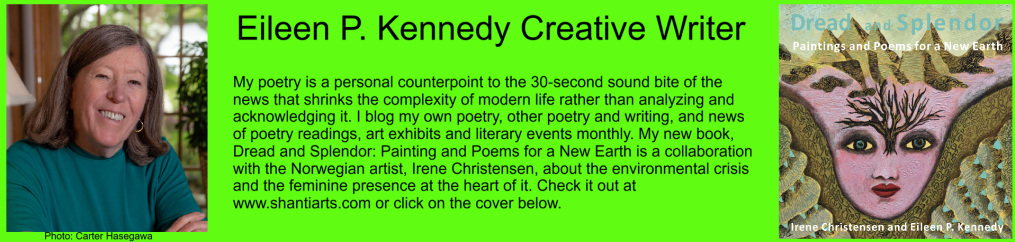
I recently finished a manuscript called Dread and Splendor: Paintings and Poems for a New Earth, with the Norwegian artist, Irene Christensen. Every time I submit a manuscript to a publisher, even though I’ve published three books, my insecurities come to play. The worst that can happen is that it will be rejected and I will submit it elsewhere.

Follow me here on Thursdays as I write about the writing process and the journey of my manuscript.

Enjoying the Process, As Well as the Product

Photo by Porapak Apichodilok on Pexels.com

“What keeps life fascinating is the constant creativity of the soul.” —Deepak Chopra

In the pursuit of success, we often focus on the end result. In so doing, we neglect interest in the journey because we want to get there as soon as possible or we lose the desire to even reach the destination.

Many artists focus on the final product, but the secret is in enjoying the process of creation

The process itself is a reward. The creative journey should interest you far more than reaching the destination. I am currently working on a manuscript, Dread and Splendor: Paintings and Poems for a New Earth, with the Norwegian artist, Irene Christensen.

We forget forget to enjoy the journey, and in effect, we lose our desire to even reach the destination.Sylvia Plath said, “The worst enemy to creativity is self-doubt.

Creativity holds great significance when it comes to connecting with our soul or authentic self.

By tuning into that creative fire that burns within, we can connect more powerfully with the soul. For some people, creativity can even be more affective at this than meditation.

When we make room for creativity in our lives and activate our creative muscles, it can be transformative. It can strengthen our intuition, release stagnant energy, and align with our larger project, like writing a book or composing a song.

I will be blogging on Thursdays. Follow me here for the journey of the manuscript, Dread and Splendor: Paintings and Poems for a New Earth.

Getting Past Your Inner Critic

“Do or do not, there is no try.” Yoda

Photo by Monstera on Pexels.com

There is a  negative voice inside all of us.  It’s the brain’s defense mechanism against danger.

Anxiety acts as a guardian angel. Its intentions are pure, but we all know the road to hell is paved with good intentions.

Anxiety protects us in life or death situations. But in day to day modern life, we rarely encounter a life or death situation that warrants such an extreme measure. Anxiety acts like a guardian, but it can cause us to not act.

The important thing to to is to reframe your anxiety,   so it doesn’t get in the way of your writing. The inner critic isn’t objective.

If what you write today doesn’t turn into something you can use, it is an exercise toward good writing. Think of it as athletic practice before you get really good. Your inner narrator should keep you grounded, but moving forward.

Every time you hear yourself thinking that the writing is not good enoughr, you tell yourself that it’s not so.

Your inner critic is far from objective.  Although its intentions are good, it won’t help you get to where you want to go.

If we try, we might fail. If we give it our all, we might fail.

So, what’s the trick?

Simple. If you’re a writer, you have to write.  It’s compulsive.  So you might as well follow your heart.

When it’s do or die, most people tend to do.

Sometimes  it’s  not massive action in order to reach a certain goal.

Our attitude always determines our altitude in life. When we think we can’t do something, there’s no reason to even try.

It’s better to try something than to give up without even attempting just because you believe that you must do it.  Thomas Edison said he re-framed his failures into “finding ways that don’t 

It’s always  better to try,  at least once or twice what can’t be done.

So remember to keep your inner critic in check.

We are the ones who decide what words we choose to write after “I am…”

I’ll be blogging on Thursdays. Follow me here.

On Writing and Depression from Leonard Cohen

Photo by Andre Moura on Pexels.com

I speak of a clinical depression that is the background of your entire life, a background of anguish and anxiety, a sense that nothing goes well, that pleasure is unavailable and all your strategies collapse. –Leonard Cohen

This quote from Leonard Cohen certainly mirrors my own feelings from time to time, especially about writing. The world often seems chaotic these days. So how do you write through it?

A writer can feel stuck when depressed. Being on a roll and suddenly having the creative juices dry up is something all creative people experience. Watching your process slowly break down until you are at a standstill. Staring at the blank page. You try to write your way out of it, but you hate every word. It connects to a larger phenomenon of lacking ideas or any endeavor that requires creativity.

Stephen King advises the “write yourself out of it” approach. Many writers believe the words we put down are indeed worthless and not worth the time. They fear ruining the piece. But the reality is sometimes we just need to write through the dry periods. Like athletes doing practice drills, we just have to keep at it until the good material comes back. If we don’t keep writing, we won’t be at our computers when the good stuff comes.

While much of writer’s block is steeped in depression, there are all sorts of other challenges that impact writing as well. Physical health, mental health, and emotional health can affect performance across. If you are struggling with depression, you might still be able to write like always, just as people with depression can joke with their friends or go through the motions at writing even though they are struggling inside.

Leonard Cohen, who suffered from depression, was certainly a model for “writing through it.” He was in the middle of composing a poem when he died. I like to think of that when I get discouraged with my writing.

I will be blogging on Thursdays. Follow me here.

Using Creativity to Navigate the World

Photo by Karolina Grabowska on Pexels.com

With all the problems in the world, many of us are involved, to survive, in self-preservation behaviors. Creative activity can be a part of self preservation.

Think of increased creative capacity as growth.We should take creative actions to improve our creative growth. If we write a poem in a new form we’ve never used before, that can read to creative growth, for instance.

People who are creative are happier, healthier, and less lonely. A published poem can lead to a reading, a painting to an exhibit, a song to a concert. All of these things put us, and our art, out into the world to see and be seen and to interact.

A creative ability is a skill to use our imagination to solve a problem. We may feel stuck with a problem, but if we read up on how other people have solved this, or ask a friend how they solved this, we are using creativity to problem-solve.

You don’t have to be an artist to exercise your creative ability. You can use this skill to fulfill dreams, problem solve, and improve communication skills.

I’ll be blogging on Thursdays. Follow me here on WordPress.

Writing In Uncertain Times

Photo by picjumbo.com on Pexels.com

We live in unprecedented times. Pandemics, wildfires, hurricanes, floods, winter storms, political unrest, economic uncertainty and war are just some of the things we deal with daily. So why write through it?

Writing is important. As writers, we bear witness to what is going on in the world and write it down. It helps to put things into perspective and forms the basis of history. When we put our thoughts down on the page, it helps to give voice for those who may not be able to put it into words. It’s a comfort when we can form our feelings into writing that other people may read.

And when we write fantasy or fiction, we are allowing ourselves and others to get lost in escape. This is important in life also, especially when people are going through such massive upheavals. You can offer people relief though your literature.

Writers are sensitive to the world around them. This takes sympathy and empathy. Writers are empathetic to the suffering of others and can sometimes put this empathy into words and thus relieve the suffering. As writers, we have the gift of being able to put our feelings into words. Nelson Mandela said, “It always seems impossible until it’s done.” 

I’ll be blogging on Thursdays. Follow me here on WordPress.

Book Launch by Tzivia Gover 6:30 pm January 11 at the Forbes Library, Northampton, MA on Dreams and Writing

BOOK LAUNCH EVENT AND CELEBRATION

Jan. 11, 6:30 -7:45, Forbes Library, Northampton, MA

Tap into Your Midnight Mind with Dreams and Writing

Learn how to use the science and psychology of sleep, dreams, and mindfulness to supercharge your creativity, and wake up to your best life with Tzivia Gover, Author of Dreaming on the Page: Tap into Your Midnight Mind to Supercharge Your Writing

Join us for a book launch and author talk about how anyone can benefit from the Dreaming on the Page method whether you remember your dreams or not, and whether or not you consider yourself a writer. Bring a pen and prepare to be inspired!

“In Dreaming on the Page Tzivia Gover provides a powerful set of tools to unleash your creativity, enhance your writing, and inspire your life.” Naomi Epel, author of Writers Dreaming

“With a warm, sure hand, Tzivia Gover guides readers through her ‘Dreaming on the Page’ process, serving up engaging historical and personal anecdotes alongside concrete advice and helpful writing prompts and exercises. Accessible and unfailingly encouraging, Dreaming on the Page proves that dreaming and writing are for everyone—and that when you combine the two, the result can be truly magical.”  Brooke Warner, Publisher of She Writes Press and author of Write On, Sisters!

Tzivia Gover is a certified dreamwork professional and the author of several books, including Dreaming on the Page, How to Sleep Tight Through the Night (with Lesléa Newman), and The Mindful Way to a Good Night’s Sleep, among others. Tzivia writes and dreams in western Massachusetts. Learn more at www.thirdhousemoon.com

Meditation and Writing

Photo by Andrea Piacquadio on Pexels.com

Many writers are also meditators. Some even write about the relationship between writing and mediation. I am a meditator and a writer. I meditate in the morning and write in the morning. I also practice yoga. To me, these are all intertwin

The U.S. alone has an estimated 36 million yoga practitioners. It has adapted to local socio-political and cultural norms world over so much so that it can hardly be called an Indian custom. Yoga originated in India. The system of yoga has physical, mental, and emotional dimensions in addition to spiritual underpinnings. But yoga is not a religion. It has no dogma. But the practice for me is essential to my writing and brings me to a place where I can write truth.

Meditation helps improve focus. Something essential for the good writer. I began meditating years ago with a meditation method popular at that time, Transcendental Meditation. Maharishi Mahesh Yogi developed this mantric method of meditation in the 50’s in India, and it spread widely throughout the world. For me, it was a good place to learn the technique, but my meditation practice evolved when I combined meditation with yoga, especially Kundalini. Kundalini is a spiritual energy or life force located at the base of the spine, conceptualized as a coiled serpent. It didn’t matter which type of meditation I was using, as long as it focused my mind and enabled me to write from that place.

Meditation provides a safe space to be. Meditation slows the world down to make room for creative thought and exploration. It’s an ideal practice for the writer or artist.

Have you had experiences with writing and meditation?

I will be blogging on Thursdays. Follow me at http://www.EileenPKennedy.com.

Langston Hughes and Spring

Photo by John-Mark Smith on Pexels.com

“Hold fast to dreams for when dreams go
Life is a barren field frozen with snow.”

–Langston Hughes

I live in the Northeastern United States and we are leaving winter behind and moving into spring. Green things are starting to pop out of the ground and the trees have small bursts that will be leaves. As a poet, I like to take out what I’ve written over the winter and see what can be used in a manuscript or for a journal submission. So I hold onto my dreams, my writing, and figure out what is worth publishing.

Some writers, like Mary Gordon, write pen on paper. I need a computer. But I need to revisit the joy of writing periodically. I also do this after a long winter. Spring is the time for renewal, to look back at the past, find what’s good, and move forward. It’s a good time to put the best of your work into manuscript form.

I will continue to blog on Thursdays, with announcements as they come up, on Tuesdays.

Using Your Dreams in Your Writing

Photo by Karyme Franu00e7a on Pexels.com

Do you dream at night? Do you remember your dreams? Have you ever used your dreams in your writing? Whatever thoughts, ideas or imaginations your mind comes up with when you sleep can be translated into creative writing.

I find the first step is to write down your dreams. Keep a notebook and pencil by your bed and write them down as soon as you wake up. Some psychologists believe that when farmers went to bed at sundown and rose at sunrise, they would wake up in the night and use the middle of the night as their creative time, including writing time.

Think of your dreams as writing prompts, rather than a whole novel. Although some fiction writers do write down their dreams. It may be a creative idea that is nagging at you to come out. The world is stressful these days, and frightening thoughts might come up, but use them as the start of a poem or story.

William Blakes “Land of Dreams” came from his very lively subconscious:

Awake, awake my little Boy!

Thou wast thy Mother’s only joy:

Why dost thou weep in thy gentle sleep?

Awake! Thy Father does thee keep.

I will blog on Thursdays, with announcements on Tuesdays, when I have them. Follow me on WordPress.