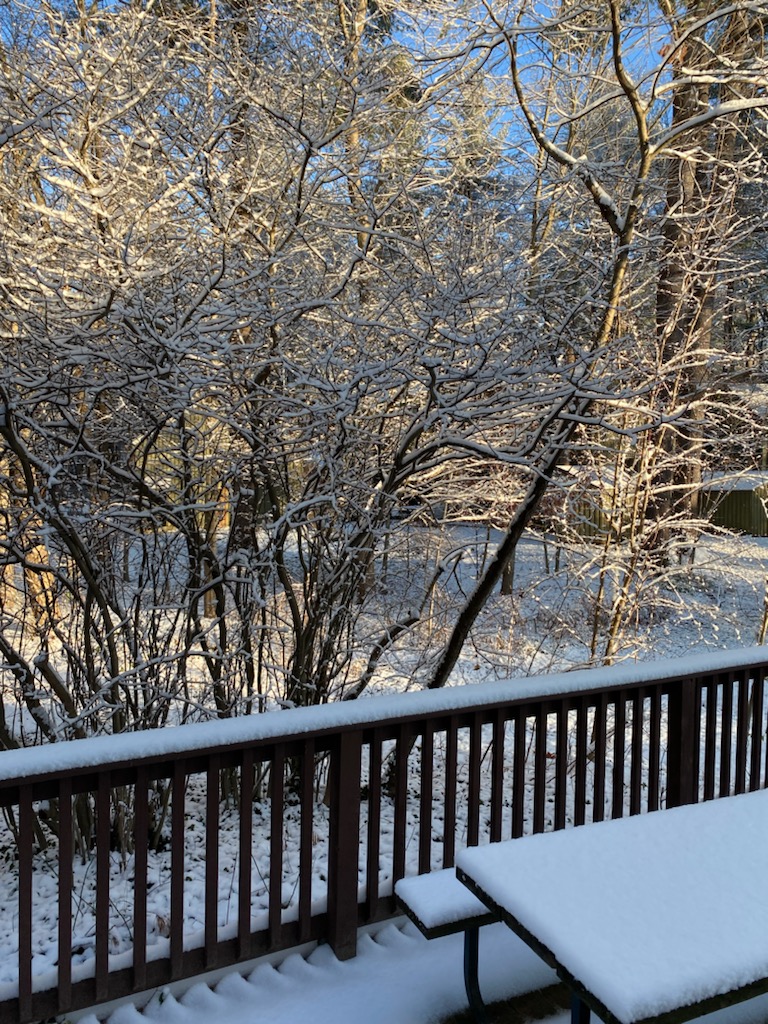
Onething I love about winter in the Northeast is the snow. This is the view from my back porch.
I love the quiet, the writerlyness of the whole thing. But how does this affect my writing? I wrote a collection of poems about my partner who died of Alzheimer’s. We had spent a lot of time in Mexico, so this landscape came into my poems:
“When I think of Oaxaco
I remember the Zocolo
where they sold pipa del agua
and chocolate dripping from paper cups.”
The setting just naturally came into the poem. Does this happen with you?
Years ago, an artists success was determined by art critics, collectors and publishers. Today, this has changed. Today these people are no longer in power and the writer is often an entrepreneur if she/he wants to make an income from her/his writing.
Vincent Van Gogh chose not to go commercial and only sold a few paintings in his life. Andy Warhol created The Factory to create and promote his work as an assembly line process. Writers also fall into different categories of commercialness. Some just prefer not to publish and read and write within circles of writing groups and friends. Others put a lot of effort into reading, blogging, working with publishers, etc. in order to sell copies. Some writers publish and promote their own books, while others publish with publishers and work in conjunction to promote the book.
Today’s artist/writer may have to brand their work, build an online presence, and stay aware and use social media trends. Margaret Atwood, with her book Testament, the sequel to A Handmaiden’s Tale, attracted hundred of fans to her book launch in London by having women dressed in red capes and white bonnets. She also simulcast it in three cities. She has been on the best-seller’s list many times.
Writers have to develop other skills besides writing to sell copies of their books. This means taking advantage of social media, blogging, and podcasting in order to reach potential customers. A writer has to decide how much time she/he wants to spend on promotion, which does take away from the creativity.
In addition to being a good starting point for a writer, journaling has other benefits. According to Leslie
Andrus-Hacia, a clinical psychiatrist Writing is a brain-based porthole leading to a balanced and calm
state of being … through writing, both right-and left-brain hemispheres communicate, synthesizing
information that ultimately results in greater mental coherence.”* Other benefits of journaling include memory support and increasing communication skills.
I like to journal on my IPhone. I always have it with me and I loaded Microsoft Word onto it so I can access the files from my IPad or MacBook. Whenever I get an idea or scrap of a thought, I enter it into my Phone Journal. I review my notes once a week to see if there is anything I want to flesh out into a poem. It’s a good system for collecting odd thoughts that otherwise would just escape you.
Sometimes those odd thoughts turn into your best work. I am publishing a new collection of poems at the beginning of the new year called Dread and Splendor: Paintings and Poems for a New Planet (Shanti Arts, 2026.) Many were from thoughts in my journal.
They say a journey of a thousand miles starts with a single step. I often think of the writing process when I hear that old adage. Writing can seem laborious when we proofread, edit, revise. These are the mundane parts of the process. The joy, for me, is in the creation, but that’s only one stage of the writing process.
So try to enjoy the journey, and not just the final, published product. Writing groups can help as you can share your writing with others and self-edit along the way. Writing is an isolating activity and a writing group can help with the isolation. You can also get helpful hints from fellow writers.
Readings can help also. Reading a work in progress can help to get feedback and it also helps to hear your work aloud. Samuel Butler says “I feel weak places at once when I read aloud where I thought, as long as I read to myself only, that the passage was alright…” The act of reading, line for line, can help the writer focus in a way that just rereading again can’t.
Years ago, an artists success was determined by art critics, collectors and publishers. Today, this has changed. Today these people are no longer in power and the writer is often an entrepreneur if she/he wants to make an income from her/his writing.
Vincent Van Gogh chose not to go commercial and only sold a few paintings in his life. Andy Warhol created The Factory to create and promote his work as an assembly line process. Writers also fall into different categories of commercialness. Some just prefer not to publish and read and write within circles of writing groups and friends. Others put a lot of effort into reading, blogging, working with publishers, etc. in order to sell copies. Some writers publish and promote their own books, while others publish with publishers and work in conjunction to promote the book.
Today’s artist/writer may have to brand their work, build an online presence, and stay aware and use social media trends. Margaret Atwood, with her book Testament, the sequel to A Handmaiden’s Tale, attracted hundred of fans to her book launch in London by having women dressed in red capes and white bonnets. She also simulcast it in three cities. She has been on the best-seller’s list many times.
Writers have to develop other skills besides writing to sell copies of their books. This means taking advantage of social media, blogging, and podcasting in order to reach potential customers. A writer has to decide how much time she/he wants to spend on promotion, which does take away from the creativity.
The difference I have noticed between successful writers who publish and people who want to be writers is the time commitment. The successful writer takes his/her writing seriously and carves out time daily to write.
The successful writer is disciplined about writing, if not daily, at regular intervals, and sticks to that schedule. We all go through periods of vacation, periods of time devoted to family and friends, but within those diversions, the writer has discipline about devoting time to the craft.
Never assume that something will get done because you’ve told yourself it will. Have a disciplined approach, and rely on writing groups, calendars, schedules, good word processing systems, in other words, the tools of the trade in good order. Then sit down and write.
It took me ten years to write my most recent collection, but I finished and published it. Take a look:
When I write, I try to use language that fits the audience and matches the content of the poem. Inappropriate language can turn your reader or listener off before you even get them started.
You want your own unique voice to come through in your writing, but you don’t want that voice to stop your reader from going on. When I read aloud to an audience, I choose different material than when I know the reader will be reading. Some writing is better heard aloud and other writing needs to be read to grasp the ideas and complexities.
When you’re in a line-up of writers at a reading, you usually only have a few minutes to grab your audience. I usually use poems with repeated lines when I read aloud, and shorter, rather than longer poems.
I will be doing a reading from my recent collection Touch My Head Softly (Finishing Line Press, 2021) at a closing reception at the Hosmer Gallery of the Forbes Library virtually. Check it out: