Every writer should keep a notebook or journal. A stray piece of paper wouldn’t do. I have always had a notebook, but I have been using my iPhone as a notebook these last few years. I find that I lose my notebook, but always have my phone. You can also use apps, such as My Journal. I was thinking about the long relationship that I’ve had with notebooks, and their centrality to everything I do, the way that they foster my creativity across years and decades.
I’m sure that’s true of most other writers. And yet, whenever I see guides to keeping a journal online, I rarely recognise my own practice in there. I’ve seen so many idealised journals, designed for public display, written in overly neat handwriting using multi-coloured pens, filled with motivational quotes and orderly bullet points. This kind of journal feels wrong to me, reeking of an overly disciplined school: the people-pleasing, self-conscious, high-pressure spaces of my school books. The tyranny of good presentation and legibility.
In my view, a notebook should be unorganized. It should be random thoughts that you want to pick up later. I’ve written many poems from random thoughts I’ve had a movies, while reading, while listening to music, or just going to the supermarket.
Your notebook should be written for nobody’s eyes but your own. It’s a completely private space, where you are the only one writing and reading. You should never show anything directly from its pages, and certainly don’t let anyone have a flick through. This gives you the freedom to write anything in it That might be my darkest thoughts or my fragile feelings; but mostly it’s just terrible writing. Be incoherent, self-pitying, tacky, boring or stupid in this space. It’s nobody else’s business.
I’ll be taking a break from blogging for the month of August. Follow me here again on Thursdays after Labor Day.
Everyone, no matter their level of success in life, struggles with their inner critic.
The negative voice tells lies to keep you safe. It’s your brain’s defense mechanism against danger.
Anxiety acts as a guardian angel. Its intentions are pure, but we all know the road to hell is paved with good intentions.
When it comes to life or death situations, your anxiety protects you. But in the trenches of day to day modern life, we rarely encounter a life or death situation that warrants such an extreme measure. Anxiety acts like a guardian, but it can cause us to not act.
Learning to reframe your anxiety is important, so it doesn’t get in the way of your writing.Because the inner critic isn’t objective, whenever you find yourself at conflict with it.
Try to imagine the good that could come out of your writing. Even if what you write today doesn’t turn into something you can use, it is an exercise toward good writing in the end. Think of yourself as an athlete who has to practice before he/she gets really good. Your inner narrator should keep you grounded without discouraging you from moving forward. Don’t silence your inner critic. Think of it as a way to go in the opposite direction of what it wants you to do.
Turn the negative self-talk into an empowering message. Every time you hear yourself thinking that you’re not good enough, that your negative traits are far too many, that it’s not worth it, that it’s not fair, you tell yourself that it’s not so.
After all, the inner critic is kind of dumb, far from objective, and even though its intentions are good, it won’t help you get to where you want to go.
Anxiety, negative self talk, self-doubt should act as triggers to turn them into something that empowers you.
Charles Bukowski almost didn’t become the writer he had always dreamt of being. He worked in a post-office until his fifties, even though he tried and often failed to earn enough from his writing so he could quit his job.
Abraham Lincoln failed time and time again. He lost his bid for State Legislature when he was 23 years old. Six years later, he lost his bid to become Speaker in the Illinois House of Representatives.In 1848, at the age of 39, Lincoln failed to become Commissioner of the General Land Office in D.C. Ten years later, he failed to become a U.S. Senator.
If we try, we might fail. If we give it our all, we might fail. Sometimes I do believe the universe tests our commitment, and I often find that the people who try and fail, never, ever want to try again.
So, what’s the trick?
Follow your heart and intuition. There’s a dream hidden somewhere inside a drawer of your soul you rarely open.
“Do or do not, there is no try.” – Yoda
This is one of those clever quotes that get passed around quite often. When it’s do or die, most people tend to do.
Sometimes we don’t have to step outside our comfort zone. Sometimes we don’t have to take massive action in order to reach a certain goal.
Have you ever chosen not to do something because you were absolutely certain you’d fail?You were so sure you couldn’t, so you didn’t even try.
Doing the impossible will often lead to failure. But if we aim to do the bit that’s possible, if we just give it a try, then we might surprise ourselves by becoming good enough to do what we previously thought of as impossible.
The obvious paradox is that you never know if something’s impossible or not unless you try.Our attitude always determines our altitude in life. When we think we can’t do something, there’s no reason to even try.
It’s better to try something than to give up without even attempting just because you believe that you must do it.
Edison’s famous invention of the light bulb stands testimony to just how powerful such a mindset is. The trick that allowed him to persevere until successful was that he re-framed his failures as, “finding ways that don’t work.”
You, like Edison, you could try to do it before you can decide if it can or can’t be done.
First you want to structure your raw idea into an organized manuscript format. This is where the outline becomes invaluable. Hopefully you have done some research before this stage and have a definite idea of how your manuscript would fit the lists of certain publishers and the overall book market.
Think about a logical sequence and flow. When I do a poetry manuscript, I think about a theme and how my recent poems fit into this theme. I might even have subsections. When I wrote Touch My Head Softly, which was about my partner and Alzheimer’s Disease, it naturally fell into three sections, before, during and after the death. When it came to publishing, my publisher immediately recognized the organization and acknowledged how it would fit into Finishing Line’s line of books for the season.
After you have shaped your outline, you can structure your material into an organized manuscript format. This is where your outline is invaluable. Think about the logical flow and sequence and divide your poems or ideas into coherent chapters and/or subsections.
If there is a chronology that makes sense, then present your content in that way. Determine what information and material belongs in the beginning, middle or end. In the end you will have a well-organized manuscript that you can present to a publisher.
This is what I did for my most recent manuscript, Dread and Splendor: Paintings and Poems for a New Earth. I will be blogging on Thursdays. Follow the progress of my manuscript here.
According to a new study by Scientific Reports* “the pattern of findings argues for shared variance between bodily movements and creativity or fluency and originality.”
Therefore many writers, including me, exercise as part of their creative process. The physical state of our bodies, and our willingness to routinely move them through space to the extent we are able, can either serve or subvert the quest to create.
There are studies about how aerobic exercise both increases the size of the prefrontal cortex and facilitates interaction between it and the amygdala. This is important to creators because the prefrontal cortex is the part of the brain that helps tamp down the amygdala’s fear and anxiety signals.
Dr. Jennifer Heisz, author of Move the Body, Heal the Mind, shares deeply compelling insights and research about the connection between movement and anxiety, depression, working memory, mental flexibility and creativity
I swim everyday first thing in the morning, then I write. I have been following this pattern for years and find it works for me. Artists, writers and any other driven creators use movement as a powerful tool in the quest to help transform the persistent uncertainty, fear, and anxiety that accompanies the quest to create,
Anyone involved in a creative endeavor might consider movement, as a potent elixir to help transform the uncomfortable sensation of anxiety from a source of pain and creative stagnation into something not only manageable but usable.
A growing body of research on the therapeutic effect of exercise on anxiety, mood, and fear illustrates the often sustained anxiety that rides organically along with the uncertainty of creation. As artists, we need to cultivate the energetic capacity needed to give our brains what they require to function long enough, and at a high enough level, to have even a shot at closing the gap between idea and performed piece or manuscript. We need to not only train in the craft, but also do what we can to equip ourselves to flourish along the way.the creative process, especially in the context of a larger work, is a survival event.
What form of exercise do you use to feed your creativity?
I will blog on Thursdays on creativity, the writing process, readings and publishing. Follow me her on Thursdays.
*“Everyday bodily movement is associated with creativity independently from active positive affect” by Rominger, et al. Scientific Reports.
The shadow of the dome of pleasure
    Floated midway on the waves;
    Where was heard the mingled measure
    From the fountain and the caves.

                    --Samuel Taylor Coleridge (1772-1834)
Coleridge wrote these lines in 1797. Just listen to the rhythm and music in the lines. Coleridge did not publish “Kubla Khan” until 1816, at Lord Byron’s insistence. Coleridge worried about the irregular meter and that sections of the poem were not coherent. Yet, it is considered one of the best poems published in the English Language.
In a sense, that’s fair enough. The poem does not hold to traditional poetic unity in the way other Coleridge work does: his long narrative poems “The Rime of the Ancient Mariner” and “Christabel,” for example, and “Frost at Midnight,” his hymn to fatherhood. The poem began in a drug-induced dream.
So how many of us writers doubt the worth of our writing? Bertrand Russell, a famous writer in his own rite, had three tips for insecure writers:
Learn to recognize your writing insecurities and admit to their existence. You can’t address a problem if you pretend it’s not there. Look at your particular insecurities and recognize them. That way you’ll be prepared when insecurity strikes.
The second is to recognize that you’re not alone in your insecurities. All writers feel insecure about their writing one time or another. If you’re insecure about grammar, work on grammar. Remember no one writes a text right the first time.
The third tip is to let go of any concept of perfectionism that you have. If you finish a text and feel you can do better, it just means that you’re developing some judgmental ability. Being insecure with your writing is part of a writer’s life.
I recently finished a manuscript called Dread and Splendor: Paintings and Poems for a New Earth, with the Norwegian artist, Irene Christensen. Every time I submit a manuscript to a publisher, even though I’ve published three books, my insecurities come to play. The worst that can happen is that it will be rejected and I will submit it elsewhere.
Follow me here on Thursdays as I write about the writing process and the journey of my manuscript.
I will be reading one of my three poems in the anthology
On Sunday, June 3 at 4 pm EST, I will be reading from the anthology, Poetry for the Dementia Journey, along with many other poets included in the anthology, including Gail Thomas, Ellen Rittberg, and Christine Jones. The book officially launches in both paperback and Kindle on June 1st – in time for Alzheimer’s and Brain Awareness Month. The book will also be published with Draft2Digital, which will put it in many other stores, such as Barnes and Noble, Kobo, and Hoopla. The eBook will sell on all platforms for $9.99 and the paperback will sell for $14.99. All royalties will benefit AlzAuthors’ mission to provide quality resources for Alzheimer’s and dementia caregivers. They are a 501(c)(3) non-profit organization. You can order a copy at: https://www.amazon.com/dp/B0D3CCK368.
You can get the zoom link by emailing a request to alzauthors@gmail.com.
Poetry for the Dementia Journey is a moving, hopeful, heartwarming collection all written from the personal experience of dementia. Within its pages, readers will find nuggets of wisdom and glimpses of joy.
Follow me here on Thursdays for more writing and book publishing news.
On Sunday, June 3 at 4 pm EST, I will be reading from the anthology, Poetry for the Dementia Journey, along with many other poets included in the anthology, including Gail Thomas, Ellen Rittberg, and Christine Jones. The book officially launches in both paperback and Kindle on June 1st – in time for Alzheimer’s and Brain Awareness Month. The book will also be published with Draft2Digital, which will put it in many other stores, such as Barnes and Noble, Kobo, and Hoopla. The eBook will sell on all platforms for $9.99 and the paperback will sell for $14.99. All royalties will benefit AlzAuthors’ mission to provide quality resources for Alzheimer’s and dementia caregivers. They are a 501(c)(3) non-profit organization. You can order a copy at: https://www.amazon.com/dp/B0D3CCK368. You can get the zoom link by emailing a request to alzauthors@gmail.com.
This is a moving, hopeful, heartwarming collection all written from the personal experience of dementia. Within its pages, readers will find nuggets of wisdom and glimpses of joy.
Follow me here on Thursdays for more book publishing news.
Zoom in to View Us at the Launch on June 3 at 4 pm.
poetry-for-dj-cover-123650291
The book officially launches in both paperback and Kindle on June 1st – in time for Alzheimer’s and Brain Awareness Month. The book will also be published with Draft2Digital, which will put it in many other stores, such as Barnes and Noble, Kobo, and Hoopla. The eBook will sell on all platforms for $9.99 and the paperback will sell for $14.99. All royalties will benefit AlzAuthors’ mission to provide quality resources for Alzheimer’s and dementia caregivers. We are a 501(c)(3) non-profit organization. You can order the book on Amazon at: https://www.amazon.com/dp/B0D3CCK368
This is a moving, hopeful, heartwarming collection all written from the personal experience of dementia. Within its pages, readers will find nuggets of wisdom and glimpses of joy.
A book launch is planned and includes a virtual reading featuring the poets on Monday, June 3 at 4:00 pm EST. I will be reading at least one of my three poems in the anthology at that time. This will be on Zoom and recorded for both our podcast and YouTube channel.
As a teacher, I relied on Bloom’s Taxonomy as a model.
As a career educator, I often used Bloom’s Taxonomy. I taught little ones on the elementary school level, and then college students. I always encouraged my students to approach study using this six-step process.
The model was named for Benjamin Bloom, who first came up with it. Here are its six levels:
Knowledge
Comprehension
Application
Analysus
Synthesis
Evaluation
So how do you use Bloom’s Taxonomy to enhance your writing process? I think Bloom’s Taxonomy can be applied to writing. You may come across an idea for your writing and research the topic and comprehend it. Then you can apply it in your writing. In the analysis phase you break down complex ideas about what you’re writing. In the synthesis part you combine the ideas you have generated in the process and make it original, or your own.
In evaluation, you make judgments about the value of what you have created and decide if it is something you want to pursue. As writers, we have all written things we don’t think work, but even if you don’t come out with something good after this process, it’s bound to lead to something worth using later. It’s an exercise in how to get through the writing process, even if it’s not working. Nothing is ever wasted in the creative process.
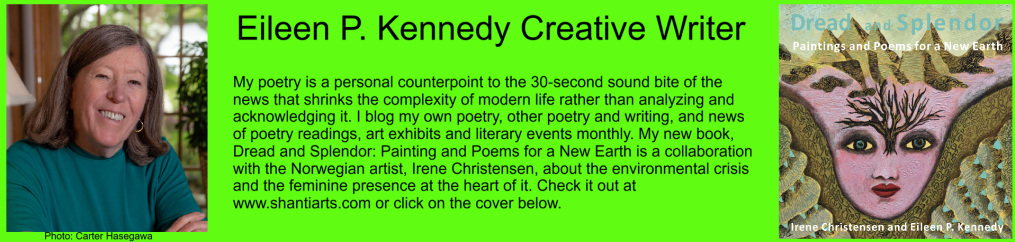
I started writing an eco-poetry manuscript on my own as I feel passionately about climate justice. Then I met the Norwegian artist, Irene Christensen, and saw some of her paintings about women at the heart of the environmental movement, and decided to collaborate with her. We came up with a 60-page manuscript of ekphrastic poems and paintings called Dread and Splendor: Paintings and Poems for a New Planet. It is currently out being considered by several publishers.
I will be blogging on Thursdays. Follow me here for blogs about the writing/publishing process and the progress of my new manuscript.






 Eileen P. Kennedy Author