Boiler House Poets Read Saturday 11am, Sept. 30 at Bear and Bee Bookshop

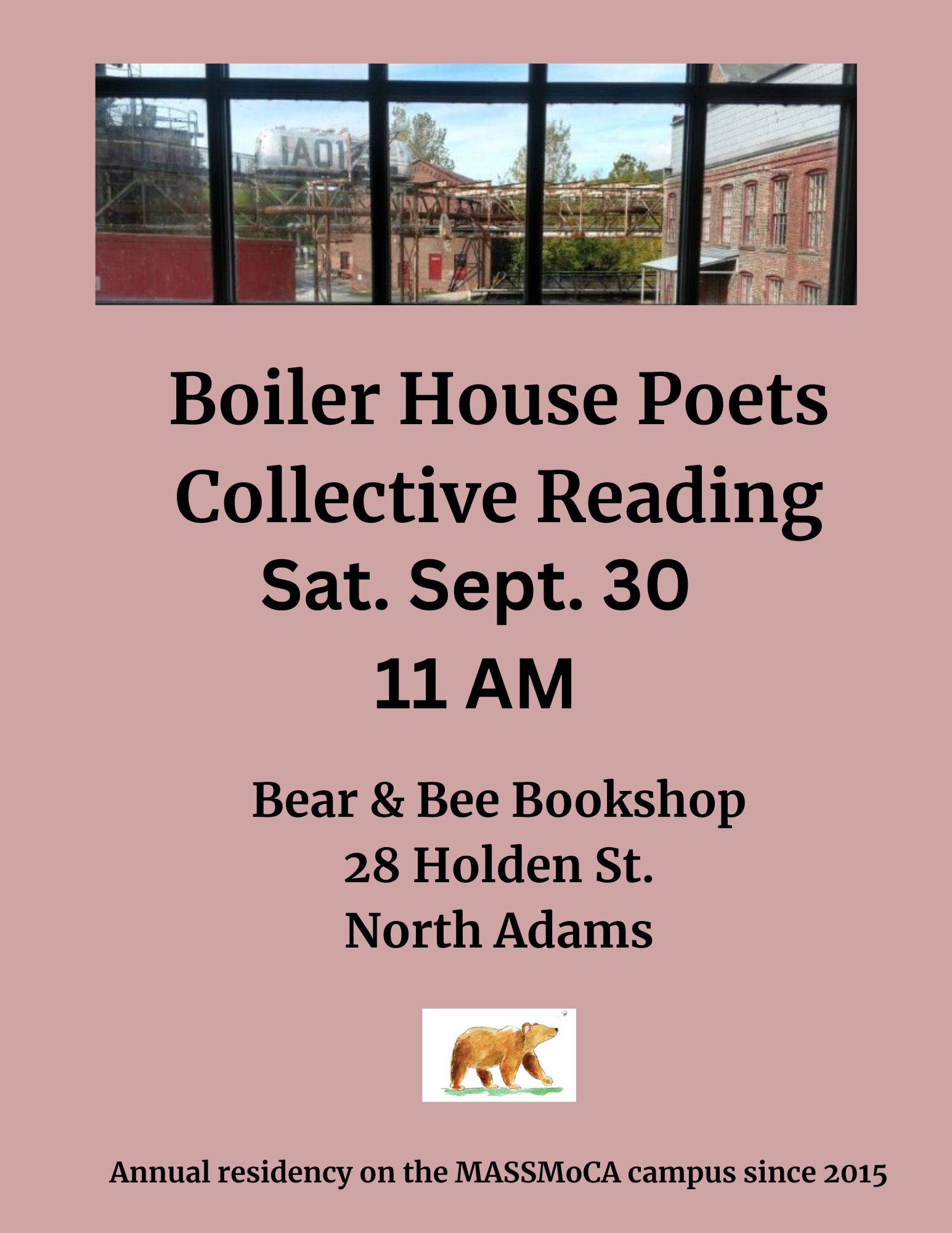
The Boiler House Poets, part of the Annual Residency at MASSMoCA, will do a collective reading on Saturday , September 30, at 11 am at Bear and Bee Bookshop, 28 Holden Street, North Adams, Massachusetts. It looks like an exciting reading.

I will continue to blog on Thursdays. If you have an upcoming reading or art exhibit, let me know and I’ll blog it.

Ekphrastic Reading Tonight at the Easthampton Art Walk

I will be reading a poem about a Shotei print, “Coming Ships,” along with many other poets, like Jennifer Delozier. The reading will take place at 5 pm on Thursday, September 14 at Eastworks, Moonlit Sea Prints Gallery at 116 Pleasant Street, Suite #226. It’s on the second floor, and there will be a flag signaling the gallery in the hallway.

The Moonlit Sea Prints Gallery features prints by many Japanese artists, including Hiroaki Takahashi (Shotei,) Kiyoharu (Ginnosuke)Yokouchi, and Hiroshi Yoshida. The Moonlit Sea Prints Gallery curates Japanese woodblock prints that touch the soul and imagination.

The Easthampton Art Walk will feature works by several galleries, but Moonlit Sea Prints in Eastworks will sponsor a reading in conjunction with their Japanese Woodblock Print Show “Stories With Shotei.”

The show will continue for a two-month period at Moonlit Sea Prints Gallery. I will continue to blog on Thursdays. If you have any readings coming up, let me know. I’ll blog them here.

Ekphrastic Reading September 14 at Moonlit Sea Prints Gallery in Easthampton Massachusetts

The Easthampton Art Walk will feature works by several galleries, but Moonlit Sea Prints in Eastworks will sponsor a reading in conjunction with their Japanese Woodblock Print Show “Stories With Shotei.”

The Moonlit Sea Prints Gallery features prints by many Japanese artists, including Hiroaki Takahashi (Shotei,) Kiyoharu (Ginnosuke)Yokouchi, and Hiroshi Yoshida. The Moonlit Sea Prints Gallery curates Japanese woodblock prints that touch the soul and imagination.

I will be reading a poem about a Shotei print, “Coming Ships,” along with many other poets, like Jennifer Delozier, who will be reading about “Two Ladies Catching Fireflies.” The reading will take place at 5 pm on Thursday, September 14 at Eastworks, Moonlit Sea Prints Gallery at 116 Pleasant Street, Suite #226. It’s on the second floor, and there will be a flag signaling the gallery in the hallway. A QR code next to the prints will allow you to read the poems on your smart phone.

Hiroaki Takahashi Shotei was a Japanese woodblock print artist of the early 20th century in the shin-hanga art movement whose work generally focused around beautiful landscapes and scenes of everyday life. Many of his works are beautiful vignettes, many easily leading the viewer to imagine the stories transpiring within the images. Moonlit Sea Prints of Easthampton MA will be presenting this exhibit, “Stories with Shotei,” showcasing the works of Hiroaki Takahashi Shotei paired with short stories

The show will continue for a two-month period at Moonlit Sea Prints Gallery. I will continue to blog on Thursdays. If you have any readings coming up, let me know. I’ll blog them here.

Literature and Writing

I taught literature many years in college. I taught adult and children’s.

It is almost impossible to go a single day without reading. Whether a social media post, email, book, or even a cereal box, we are constantly reading words. What is classified as literature vs technical writing?

There are two main separations between writing and literature. The first is the intended audience, or rather, the intention of the audience when reading, and the second is the author’s intenti when writing.

Photo by Iu015fu0131l on Pexels.com

Literature, and the reading of it, has saved many people in difficult situations. Literature can show people at their best. If you’re living through a difficult situation, say prison, this can be an important hope and message. Words can teach, illuminate and inspire us. Nelson Mandella cites the books he read in jail that gave him solace during his long incarceration. He devoured anything he could read on armed combat because he was trying to form a Liberation Army. As a young strategist, he read about boxing when he tried to defeat his opponents in the ring or books on chess when he was competing in chess tournaments. “I had no time to brood. I enjoyed reading and writing letters and that occupied my mind completely…” says Mandela.

Most prisons have a library and prisoners are encouraged to read books. According to most state statutes, prisoners are entitled to legal texts to research their own appeals. In addition to lawl books, almost all libraries have literature. Sometimes there are limits on content, like rape or gun construction, but overall there is much literature available to inmates. Some of the most popular in prisons are Stephen King and Harry Potter novels. Orange is the New Black and Gone Girl are some of the most popular novels in prisons. Longer novels are also popular, like Ayn Rands The Fountainhead. Biographies of different famous Americans are also sought-after in prison.

I will be blogging on Thursdays. Follow me here.

Anton Chekhov on Description

“Don’t tell me the moon is shining; show me the glint of light on broken glass.” – Anton ChekhovIMG_0187

To vividly describing a place, person, or thing is to imagine it in your mind’s eye. If it exists you may prefer to look at it or a photograph. Either way, you’ll start with some scene before you without dividing it into objects or attaching any words to it. Just form an impression of the colors, textures, shapes, and feeling.

Most importantly, refrain from your impulse to name them. Just picture and observe.

Then, be careful to select the right words to convey the place. If the words that come to mind don’t seem adequate, look in a dictionary, ask around, or do some research. Be sure to keep searching until you have the closest match possible between observation and language. While it’s okay to stop short of perfection, since words and thought inevitably fail to capture perception, keep revising until you can’t think of any way to improve your description further.

Instead of allowing the meaning you want to express to decide the words, you can be seduced by alliteration, rhythm and other sonic features, or fail to escape from customary phrasing, and allow language itself to decide what it is you want to say. This is for description in fiction or nonfiction. Poetry, of course, calls out for those sonic features.

In this way your description will serve you well in your writing.

I will blog on Thursdays. Follow me here.
Insecurity in Writing

Photo by Tom Swinnen on Pexels.com

I’ve often heard the expression, “I’m not ready to write.” We all feel insecure when we’re not sure what “it” is.

Sometimes the material we’ve written comes from the imagination, memory, dreams, and who knows where. Sometimes it’s elusive and genre-bending. What on earth should we do with it in the bright light of day to “make it better”? To ensure it’s a “real piece”?

To nurture our creativity, we all need supportive spaces. We need to do our best, but not pressure for more and more. We should renew our inner resources to overcome obstacles and difficulties.

Especially in these difficult times with wars and pandemic, we need to remind ourselves of the beauty that exists. We need the support of our fellow artists.

I remember seeing on television a cello player performing amidst the rubble of bombed out buildings after an attack by the Russian army on his Ukrainian village. When interviewed, he said, “We’ll rebuild.” His message was one of hope through creativity. It’s an antidote for despair. What do you do to nature your creativity?

I’ll be blogging on Thursdays. Follow me on WordPress at https://www.eileenpkennedy.com.

Thank You to Vita Brevis Press for Publishing Two of My Poems

I am grateful to Vita Brevis Press for publishing my poems:

3 a.m.

Respiratory

in What is All This Sweet Work?: A Poetry Anthology About Love and Loss (2022). Take a look.

Reading Deprivation

Photo by Pixabay on Pexels.com

For writers, reading is a way of life. We read early and often. We read, we write. We check our media contacts, read newspapers or magazines online or in hard copy, then read a text of something similar to what we are working on in our own writing. If we stop reading, it’s deprivation.

It’s a paradox that by emptying our lives of all that text and distraction, we are actually refreshing the wellspring. By absenting ourselves from all the media, we get in touch with our inner selves, which is where all the creativity comes from. By keeping the inflow to a minimum, the outflow improves. Our true thoughts and feelings will begin to penetrate and come out in new writing, running freely. I knew a playwright who would take off his shoes and socks and stand in a running stream with a paper and pencil to literally get his flow going.

If you find not reading difficult, and many writers do, here are some suggestions:

.listen to music that has no words

.sew

.repot plants

.cook a complicated, time-consuming recipe and then

.invite friends to dinner

.watercolor

.rearrange the kitchen

.exercise

.meditate

.dance

After a number of these activities, sit down and write again. Notice any differences in your feelings or content. Your writing may benefit.

Follow me here on Thursdays.

Failure Is Part of the Creative Process

Photo by Steve Johnson on Pexels.com

Trying out new things is part of the creative process. Things can change at any stage in a painting’s or manuscript’s development. 

The writing process is an exciting and adventurous process. It sometimes feels electrifying and at other times, downright discouraging.  A writer needs to go in knowing that it might not work.   It means that results don’t matter as much as the process, the joy and the journey.

I try to keep this in mind every time I sit down at a blank page. An athlete has to work out to get to a point where she wins the competition. A writer sometimes has to fail many times before succeeding.

You may think that what you wrote is terrible, but it may work out later in a future draft, or help you get, through experimentation, to a wonderful manuscript. t’s part of the journey to that wonderful piece that finally works.

I’ll be blogging on Thursdays about the writing process. Follow me on WordPress at http://www.eileenpkennedy.com