Have you ever thought “I have a book inside me, waiting to be written”? As an aspiring author myself, I know that yearning all too well. I spent a lot of time staring hopelessly at blank pages, willing the words to flow but finding only frustration. My dream of writing a book felt out of reach. You may be creative, but if you’re staring at a blank page, it doesn’t matter.
People who are creative are happier, healthier, and less lonely. A published poem can lead to a reading, a painting to an exhibit, a song to a concert. I recently wrote an ekphrastic poem recently to my friend’s painting and she sold it, with the poem. All of these things put us, and our art, out into the world to see and be seen and to interact.
A creative ability is a skill to use our imagination to solve a problem. We may feel stuck with a problem, but if we read up on how other people have solved this, or ask a friend how they solved this, we are using creativity to problem-solve.
You don’t have to be an artist to exercise your creative ability. You can use this skill to fulfill dreams, problem solve, and improve communication skills.
Follow me here. ‘ll be blogging on Thursdays. Good luck with your creative endeavors.
There’s no money and little interest in poetry. One of the reasons for lack of interest in poetry is the way it was taught in school. You were taught to find a meaning, which is work, like cracking open a walnut and digging out the meat. Sometimes poets add to their own problems by making their poems difficult to understand. A poet has to learn to connect with the audience.
So why do we become poets?
We become poets because we love poetry. When I read a good poem, it totally nourishes me. When I write a good poem, there’s no better feeling. Louise Nevelson, the sculptor, said “I’d rather work twenty-four hours a day in my studio and come in here and fall down on the bed than do anything.”
Seamus Heaney, the Nobel-Prize winning poet said “The aim of the poet and the poetry is finally to be of service to ply the effort of at the individual work into the larger work of the community as a whole.” Here he says the poet makes a contribution to society as a whole. Though it’s amazing to write a poem that pleases the author, to write something that touches the reader is about as good as it gets.
Letting the poem become part of your experience is invaluable. If you read a poem about a robin that touches you, it re-freshens the world. The next time you take a walk and see a robin, you will notice it.
Poets read other poets. This teaches us to write the kind of poems we like to read.
Writing poems can be exhilarating. Joy Harjo the Poet Laureate, says “I don’t know when the first poem was, where it came from, or exactly how. I just know how much I needed it…I was in the dark and decided to investigate the dark to find the light.” Writing poetry is just that, finding the light in the dark.
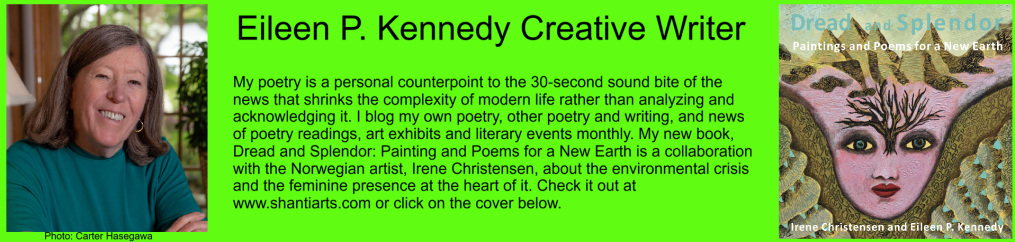
I collaborated on an eco-poetry manuscript with the Norwegian Artist, Irene Christensen called Dread and Splendor: Paintings and Poems for a New Earth. It’s currently out with publishers being considered for publication.
I’ll be blogging on Thursdays. Follow me here. Let me know about your own writing experiences and I’ll blog about the journey of my eco-poetry manuscript.
As a writer, I spend a lot of time in my study. This is a room that need only be inviting to one person—the one who inhabits it. I have a friend who has a very organized study with a clear desk. Unlike my desk, this one is s spacious and clear of the piles of work in progress that amass on my own. She recently pared down her book collection to fit on one small bookshelf. My office, by contrast, has four mismatched shelf units, each overstuffed with reference books, novels I hope to read one day, books on language and literacy, books relating to current projects, and stacks that I hope to get to “soon.” I love my office. Its creative chaos suits me and mirrors my writing process.
I find that writers have very different writing spaces that work uniquely for them. I know someone who works in a coffee shop in the town she lives in. She orders her favorite coffee and stays for the morning. Another friend writes in the library. She likes the quiet it affords her.
I can write in many different settings, at retreats, in my own studio, in writing groups, in the library, in coffee shops.
Where do you like to write? What fits your writing style, your process, your mood? This study is where I created my latest manuscript, Dread and Splendor: Paintings and Poems for a New Planet. It’s my first collaborative manuscript with my Norwegian artist friend, Irene Christensen.
I’ll be blogging on Thursdays. Follow my blog here and the progress of my manuscript.
“What keeps life fascinating is the constant creativity of the soul.” —Deepak Chopra
In the pursuit of success, we often focus on the end result. In so doing, we neglect interest in the journey because we want to get there as soon as possible or we lose the desire to even reach the destination.
Many artists focus on the final product, but the secret is in enjoying the process of creation
The process itself is a reward. The creative journey should interest you far more than reaching the destination. I am currently working on a manuscript, Dread and Splendor: Paintings and Poems for a New Earth, with the Norwegian artist, Irene Christensen.
We forget forget to enjoy the journey, and in effect, we lose our desire to even reach the destination.Sylvia Plath said, “The worst enemy to creativity is self-doubt.
Creativity holds great significance when it comes to connecting with our soul or authentic self.
By tuning into that creative fire that burns within, we can connect more powerfully with the soul. For some people, creativity can even be more affective at this than meditation.
When we make room for creativity in our lives and activate our creative muscles, it can be transformative. It can strengthen our intuition, release stagnant energy, and align with our larger project, like writing a book or composing a song.
I will be blogging on Thursdays. Follow me here for the journey of the manuscript, Dread and Splendor: Paintings and Poems for a New Earth.
Gallery of Readers, one of Western Massachusetts prime publishers and leader of writing workshops, will sponsor a reading on Sunday, November 19 at 4 pm at the Friends Meeting House of Northampton, 43 Center Street. The reading is available in person or on zoom.
Barbara A. Rouillard will read from her memoir, I Don’t Mind Waiting for You. Barbara is an award-winning writer with 85 publishing credits and the recipient of an NEH Fellowship and a Massachusetts Cultural Council Grant.
Eileen P. Kennedy will be reading from her two poetry collections, Banshees (Flutter Press, 2016) Touch My Head Softly (Finishing Line Press, 2021) and her new eco-poetry manuscript Dreadful Splendor: Paintings and Poems for a New Planet which she collaborated on with the Norwegian Artist, Irene Christensen.
If you want the zoom link, contact me here. Follow me here. I blog on Thursdays.
As a career educator, I often used Bloom’s Taxonomy. I taught little ones on the elementary school level, and then college students. I always encouraged my students to approach study using this six-step process.
The model was named for Benjamin Bloom, who first came up with it. It has six levels:
Knowledge
Comprehension
Application
Analysus
Synthesis
Evaluation
I think Bloom’s Taxonomy can be applied to writing. You may come across an idea for your writing and research the topic and comprehend it. Then you can apply it in your writing. In the analysis phase you break down complex ideas about what you’re writing. In the synthesis part you combine the ideas you have generated in the process and make it original, or your own.
Finally in evaluation, you make judgments about the value of what you have created and decide if it is something you want to pursue. As writers, we have all written things we don’t think work, but even if you don’t come out with something good after this process, it’s bound to lead to something worth using later. Nothing is ever wasted in the creative process.
I will be take a hiatus from blogging for the summer, but will be back blogging on Thursdays in September. Have a great summer and look for me here in the fall.
There is a negative voice inside all of us. It’s the brain’s defense mechanism against danger.
Anxiety acts as a guardian angel. Its intentions are pure, but we all know the road to hell is paved with good intentions.
Anxiety protects us in life or death situations. But in day to day modern life, we rarely encounter a life or death situation that warrants such an extreme measure. Anxiety acts like a guardian, but it can cause us to not act.
The important thing to to is to reframe your anxiety, so it doesn’t get in the way of your writing. The inner critic isn’t objective.
If what you write today doesn’t turn into something you can use, it is an exercise toward good writing. Think of it as athletic practice before you get really good. Your inner narrator should keep you grounded, but moving forward.
Every time you hear yourself thinking that the writing is not good enoughr, you tell yourself that it’s not so.
Your inner critic is far from objective. Although its intentions are good, it won’t help you get to where you want to go.
If we try, we might fail. If we give it our all, we might fail.
So, what’s the trick?
Simple. If you’re a writer, you have to write. It’s compulsive. So you might as well follow your heart.
When it’s do or die, most people tend to do.
Sometimes it’s not massive action in order to reach a certain goal.
Our attitude always determines our altitude in life. When we think we can’t do something, there’s no reason to even try.
It’s better to try something than to give up without even attempting just because you believe that you must do it. Thomas Edison said he re-framed his failures into “finding ways that don’t
It’s always better to try, at least once or twice what can’t be done.
So remember to keep your inner critic in check.
We are the ones who decide what words we choose to write after “I am…”
I taught literature many years in college. I taught adult and children’s.
It is almost impossible to go a single day without reading. Whether a social media post, email, book, or even a cereal box, we are constantly reading words. What is classified as literature vs technical writing?
There are two main separations between writing and literature. The first is the intended audience, or rather, the intention of the audience when reading, and the second is the author’s intenti when writing.
Literature, and the reading of it, has saved many people in difficult situations. Literature can show people at their best. If you’re living through a difficult situation, say prison, this can be an important hope and message. Words can teach, illuminate and inspire us. Nelson Mandella cites the books he read in jail that gave him solace during his long incarceration. He devoured anything he could read on armed combat because he was trying to form a Liberation Army. As a young strategist, he read about boxing when he tried to defeat his opponents in the ring or books on chess when he was competing in chess tournaments. “I had no time to brood. I enjoyed reading and writing letters and that occupied my mind completely…” says Mandela.
Most prisons have a library and prisoners are encouraged to read books. According to most state statutes, prisoners are entitled to legal texts to research their own appeals. In addition to lawl books, almost all libraries have literature. Sometimes there are limits on content, like rape or gun construction, but overall there is much literature available to inmates. Some of the most popular in prisons are Stephen King and Harry Potter novels. Orange is theNew Black and Gone Girl are some of the most popular novels in prisons. Longer novels are also popular, like Ayn Rands The Fountainhead. Biographies of different famous Americans are also sought-after in prison.
The inner critic is always there for the writer. The negative voice tells lies to keep you safe. It’s your brain’s defense mechanism against danger.Anxiety acts as a guardian angel. Its intentions are pure, but we all know the road to hell is paved with good intentions.
When it comes to life or death situations, your anxiety protects you. But in the trenches of day to day modern life, we rarely encounter a life or death situation that warrants such an extreme measure. Anxiety acts like a guardian, but it can cause us to not act.
Learning to reframe your anxiety is important, so it doesn’t get in the way of your writing.Because the inner critic isn’t objective, whenever you find yourself at conflict with it.
Try to imagine the good that could come out of your writing. Even if what you write today doesn’t turn into something you can use, it is an exercise toward good writing in the end. Think of yourself as an athlete who has to practice before he/she gets really good. Your inner narrator should keep you grounded without discouraging you from moving forward. Don’t silence your inner critic. Think of it as a way to go in the opposite direction of what it wants you to do.
Turn the negative self-talk into an empowering message. Every time you hear yourself thinking that you’re not good enough, that your negative traits are far too many, that it’s not worth it, that it’s not fair, you tell yourself that it’s not so.
After all, the inner critic is kind of dumb, far from objective, and even though its intentions are good, it won’t help you get to where you want to go.
Anxiety, negative self talk, self-doubt should act as triggers to turn them into something that empowers you.
Charles Bukowski almost didn’t become the writer he had always dreamt of being. He worked in a post-office until his fifties, even though he tried and often failed to earn enough from his writing so he could quit his job.
Abraham Lincoln failed time and time again. He lost his bid for State Legislature when he was 23 years old. Six years later, he lost his bid to become Speaker in the Illinois House of Representatives.
In 1848, at the age of 39, Lincoln failed to become Commissioner of the General Land Office in D.C. Ten years later, he failed to become a U.S. Senator.
Colonel Harland Sanders is another famous failure. It was not until he was 65 years old, with just $105 to his name, that he set out to sell his franchise. He was rejected by 1,009 restaurants before one agreed to his business model.
If we try, we might fail. If we give it our all, we might fail.
Sometimes I do believe the universe tests our commitment, and I often find that the people who try and fail, never, ever want to try again.
So, what’s the trick? Simple. The trick is to be. Follow your heart and intuition. There’s a dream hidden somewhere inside a drawer of your soul you rarely open.
“Do or do not, there is no try.” – Yoda
This is one of those clever quotes that get passed around quite often.When it’s do or die, most people tend to do.
Sometimes we don’t have to step outside our comfort zone. Sometimes we don’t have to take massive action in order to reach a certain goal. And sometimes we just can’t do it, and the Nike approach to life is only going to frustrate us into giving up or having a mental breakdown.
Have you ever chosen not to do something because you were absolutely certain you’d fail? You were so sure you couldn’t, so you didn’t even try. It felt impossible, and the thing with impossible is that:
a. You can’t do it.
b. It’s only two letters too long.
Doing the impossible will often lead to failure. But if we aim to do the bit that’s possible, if we just give it a try, then we might surprise ourselves by becoming good enough to do what we previously thought of as impossible.
The obvious paradox is that you never know if something’s impossible or not unless you try.Our attitude always determines our altitude in life. When we think we can’t do something, there’s no reason to even try.
It’s better to try something than to give up without even attempting just because you believe that you must do it.
Edison’s famous invention of the light bulb stands testimony to just how powerful such a mindset is. The trick that allowed him to persevere until successful was that he re-framed his failures as, “finding ways that don’t work.”
You, like Edison, must try to do it before you can decide if it can or can’t be done.
Always try. At least once or twice. It’s far better than doing nothing because it can’t be done.
The ego is simply the story you tell yourself about who you are, who you wish you could be, and who you’d never want to become. That’s it. The people who make their dreams come true tell themselves a story that goes like this: they are who they are, regardless of failure, setbacks, or opposition.
They are not defined by external factors. They are fueled from within, by the very definition they have chosen for themselves, and set out to find the circumstances that allow them to make that definition even more potent by making their dream come true.
The people who fail in life, however, try, again and again, to get the validation they think they need to finally be able to call themselves “writer” or “painter” or “entrepreneur.”
As we’ve discussed previously, it doesn’t work like that. First, you must be. Then, you must try.The world changes its opinion of you the day after you do.
You will change your limiting beliefs by first understanding that you are the one writing your inner narrative. You are the storyteller, the main character, the villain, and just like in a dream, everyone you meet is a reflection of who you are or wish to become.
Rather than clinging to your limiting beliefs, giving in to your inner critic, you try to test the very fabric of your soul. Venturing into the center of your fears, you will often discover that what you were most afraid of was fear itself.
You will realize that feeling unattractive doesn’t necessarily mean you are so. If you consciously decide to go beyond what your brain tells you is the most you are capable of, you will soon begin to do the impossible: you will start writing the story you’ve always wanted to write.
We often prefer the discomfort of being less than our ideal selves because the opposite brings with it the discomfort of uncertainty.
It’s not the decision to change that counts, but actively trying to change. We cannot remake ourselves without pain, and we must go through the discomfort of building a new self.
When we direct our gaze towards the stars, and we realize that we are capable of reaching for them, we must do everything in our power to internalize and act upon this belief.
It means you’ll need to look for confirmation that you are the exact opposite of what your inner critic is telling you, and repetition is essential. You have to do it over and over again until you become emotionally aware of this new reality of who you are.



 Eileen P. Kennedy Author