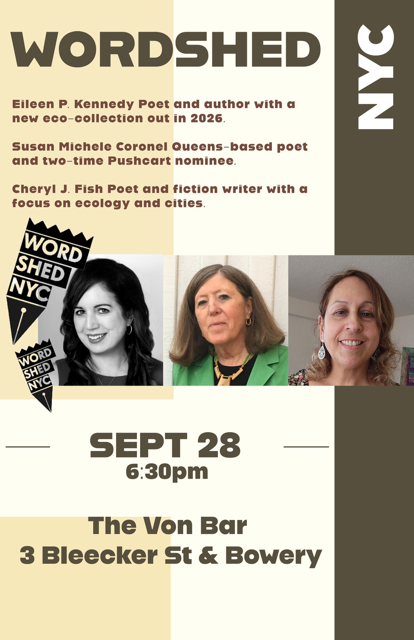
Come join us if you are in the area. I will be blogging again monthly about the new book.

Titles of books, short stories, poems, are very important.
Corporations spend millions to find the name of a product. Thought should be put into how you title your creative product.
Let’s discuss book titles. The first thing anyone hears about is the title of your book. It even precedes the cover. Once the artist knows what the title is, he/she can work on the visual concept. Think about what you will call your book. Here are some things to think about:
.It should give an idea of what the book is about.
.It should be easy to say.
.It should be memorable.
.It should grab your attention.
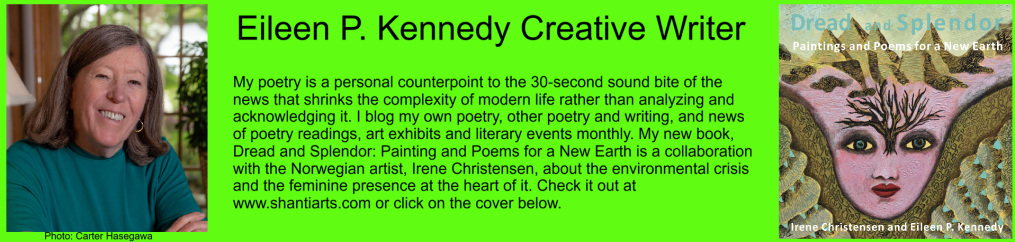
When we were deciding on a title for our manuscript, Dread and Splendor: Paintings and Poems for a New Earth, we tried out a lot of titles. The first one was “Dreadful Splendor” from a W.B. Yeats poem. This was taken by a previous book, so we changed it to “Dread and Splendor.” We thought this encompassed the “splendor” of the art and poems and the “dread” of the environmental crisis. Then we decided this didn’t really tell what the book was about and we added the subtitle “Paintings and Poems.” At first we had “Paintings and Poems for a New Planet.” But then we thought it sounded too much like speculative or science fiction. So it became “Dread and Splendor: Paintings and Poems for a New Earth.”
The same is true of a short story, poem or play title. Editors look at hundreds of poems and short stories.
If you follow the guidelines above, you’ll draw attention to your piece from the beginning and have less change of being passed over.
Sometimes for titles a phrase can be used from the manuscript can be just the right thing. If you have a concept that is long, write it down and then edit it.
Try discussing your book using the title and seeing if people understand and appreciate what you’re saying. See if they ask questions and are interested in the title and what you have to say.
Choosing the perfect title is mostly about trial and error. If you try out a number of titles, the best one becomes clear.
I will be blogging monthly, taking about the production of Dread and Splendor: Paintings and Poems for a New Planet through publication and beyond. Follow me here.
Voice is a rather abstract concept in writing and fiction generally. But it’s so important that it deserves mention as one of the core aspects of writing. Voice, quite simply, is what the narrator sounds like. Voice includes the narrator’s emotions, attitudes, perspective, and tone.
As you read the piece, you can hear the narrator’s voice in your head, and the voice leaps out in a particular and funny way. This is especially true in pieces where the narrator is some kind of interesting or unusual character.

Additionally, voice is multi-layered. It includes both the general writing voice of an author, as well as individual voices that are tied to specific pieces of writing. In poetry, you can write a narrative poem in all kinds of voices.
Some writer’s tones are incredibly distinctive, and their sentence structure, length, word choice, and the way the paragraphs flow are original to their writing. In a longer literary work, readers will likely come across different voices as writers create different characters. When considering the difference between the author’s voice and the character’s voice, it’s important to pay attention to when one is used. A character’s voice is specific to a character in a literary work. It is created in order to define them as an individual. Readers should be able to tell the difference between major characters based on their speaking. One character might be well-educated and prone to using large words, while another might have more basic education and find the former’s use of language elitist.
When using a third-person narrative, the narrator is omniscient or outside and telling about the action. “Half a league, Half a league onward, into the valley of death, rode the six hundred.*” is a famous example of third-person narrative.
First-Person narrative is another way to tell a story. Edna St. Vincent Millay’s “What My Lips Have Kissed and Where and Why” begins “What lips my lips have kissed, and where, and why, I have forgotten, and what arms have lain under my head till morning; but the rain Is full of ghosts tonight, that tap and sigh…” Or this famous line from “The Telltale Heart,” by Edgar Allen Poe It was the beating of the old man’s heart. It increased my fury, as the beating of a drum stimulates the soldier into courage.” The speaker of a first-person narrative does not necessarily have to be the author, but can be totally invented.
However you choose to tell your story, choose your narrator wisely. It will really make a difference in your piece. Follow me here the beginning of the month as I blog about writing, the writing process, and publishing.
*”The Charge of the Light Brigade,” by Alfred Lord Tennyson.

Have you ever thought “I have a book inside me, waiting to be written”? As an aspiring author myself, I know that yearning all too well. I spent a lot of time staring hopelessly at blank pages, willing the words to flow but finding only frustration. My dream of writing a book felt out of reach. You may be creative, but if you’re staring at a blank page, it doesn’t matter.
People who are creative are happier, healthier, and less lonely. A published poem can lead to a reading, a painting to an exhibit, a song to a concert. I recently wrote an ekphrastic poem recently to my friend’s painting and she sold it, with the poem. All of these things put us, and our art, out into the world to see and be seen and to interact.
A creative ability is a skill to use our imagination to solve a problem. We may feel stuck with a problem, but if we read up on how other people have solved this, or ask a friend how they solved this, we are using creativity to problem-solve.
You don’t have to be an artist to exercise your creative ability. You can use this skill to fulfill dreams, problem solve, and improve communication skills.
Follow me here. ‘ll be blogging on Thursdays. Good luck with your creative endeavors.

There’s no money and little interest in poetry. One of the reasons for lack of interest in poetry is the way it was taught in school. You were taught to find a meaning, which is work, like cracking open a walnut and digging out the meat. Sometimes poets add to their own problems by making their poems difficult to understand. A poet has to learn to connect with the audience.
So why do we become poets?
We become poets because we love poetry. When I read a good poem, it totally nourishes me. When I write a good poem, there’s no better feeling. Louise Nevelson, the sculptor, said “I’d rather work twenty-four hours a day in my studio and come in here and fall down on the bed than do anything.”
Seamus Heaney, the Nobel-Prize winning poet said “The aim of the poet and the poetry is finally to be of service to ply the effort of at the individual work into the larger work of the community as a whole.” Here he says the poet makes a contribution to society as a whole. Though it’s amazing to write a poem that pleases the author, to write something that touches the reader is about as good as it gets.
Letting the poem become part of your experience is invaluable. If you read a poem about a robin that touches you, it re-freshens the world. The next time you take a walk and see a robin, you will notice it.
Poets read other poets. This teaches us to write the kind of poems we like to read.
Writing poems can be exhilarating. Joy Harjo the Poet Laureate, says “I don’t know when the first poem was, where it came from, or exactly how. I just know how much I needed it…I was in the dark and decided to investigate the dark to find the light.” Writing poetry is just that, finding the light in the dark.
I collaborated on an eco-poetry manuscript with the Norwegian Artist, Irene Christensen called Dread and Splendor: Paintings and Poems for a New Earth. It’s currently out with publishers being considered for publication.
I’ll be blogging on Thursdays. Follow me here. Let me know about your own writing experiences and I’ll blog about the journey of my eco-poetry manuscript.


“What keeps life fascinating is the constant creativity of the soul.” —Deepak Chopra
In the pursuit of success, we often focus on the end result. In so doing, we neglect interest in the journey because we want to get there as soon as possible or we lose the desire to even reach the destination.
Many artists focus on the final product, but the secret is in enjoying the process of creation
The process itself is a reward. The creative journey should interest you far more than reaching the destination. I am currently working on a manuscript, Dread and Splendor: Paintings and Poems for a New Earth, with the Norwegian artist, Irene Christensen.
We forget forget to enjoy the journey, and in effect, we lose our desire to even reach the destination.Sylvia Plath said, “The worst enemy to creativity is self-doubt.
Creativity holds great significance when it comes to connecting with our soul or authentic self.
By tuning into that creative fire that burns within, we can connect more powerfully with the soul. For some people, creativity can even be more affective at this than meditation.
When we make room for creativity in our lives and activate our creative muscles, it can be transformative. It can strengthen our intuition, release stagnant energy, and align with our larger project, like writing a book or composing a song.
I will be blogging on Thursdays. Follow me here for the journey of the manuscript, Dread and Splendor: Paintings and Poems for a New Earth.

As writers, we often feel that we don’t do enough. We don’t put enough hours into our writing,
we don’t do enough research before writing, and we don’t publish enough. When you finish a
piece of writing, give yourself a pat on the back: You finished a piece of creative writing—
something many attempt, but not quite as many achieve. I recently finished a manuscript called
Dread and Splendor: Paintings and Poems for a New Earth. I collaborated on it with the
Norwegian Artist, Irene Christensen. It’s a collection about the climate crisis and women at the
heart of it. I feel good about completing it.
Some writers consider the worth of their writing in the published pieces, but others don’t even
attempt to publish. The reward for them is in the process. You can share your writing at an
open-mic reading. You can post it online or bring it to an in-person writing group for
constructive critique. You can send it to a friend.
You can send it to a literary journal or an agent for possible publication, but that’s a topic for
another blog. As writers, we need to acknowledge our accomplishments for ourselves.
I’ll be blogging Thursdays about the writing process. Follow me here.
SAVE THE DATE: THE GLOUCESTER WRITERS CENTER PRESENTS WRITER-IN-RESIDENCE CHERYL J. FISH ON FRIDAY, OCT. 20 AT 7 PM.
Cheryl J. Fish, author of the debut novel OFF THE YOGA MAT and the poetry collection THE SAUNA IS FULL OF MAIDS will be reading and in conversation with Gloucester Writing Center member/poet Heidi Wakeman about writing novels and poems based on travels, friendships, coming of middle age, and the role of yoga and sauna in Fish’s fiction and poetry.
Friday, Oct. 20 at 7 p.m.
At THE LITTLE ARTS CINEMA 19 School St, Rockport, MA 01966. THERE WILL BE A Q&A AND BOOK SIGNING. For more information, contact Eric Parkison, eric@gloucesterwriters.org
“Fish’s debut novel Off the Yoga Mat is smart, soulful, and surprising,”
Bonnie Jo Campbell, author of The Waters (Jan. 2024 from WW Norton)
“The Sauna is Full of Maids illustrates ‘a longing for
eternal things.'” These timeless essentials include friendship and the naked democracy of the sauna.” Paul Hoover, author of O, and Green.

I will be blogging on Thursdays. If you have an upcoming reading let me know, and I’ll blog it.
Follow me here.

As a career educator, I often used Bloom’s Taxonomy. I taught little ones on the elementary school level, and then college students. I always encouraged my students to approach study using this six-step process.
The model was named for Benjamin Bloom, who first came up with it. It has six levels:
I think Bloom’s Taxonomy can be applied to writing. You may come across an idea for your writing and research the topic and comprehend it. Then you can apply it in your writing. In the analysis phase you break down complex ideas about what you’re writing. In the synthesis part you combine the ideas you have generated in the process and make it original, or your own.
Finally in evaluation, you make judgments about the value of what you have created and decide if it is something you want to pursue. As writers, we have all written things we don’t think work, but even if you don’t come out with something good after this process, it’s bound to lead to something worth using later. Nothing is ever wasted in the creative process.
I will be take a hiatus from blogging for the summer, but will be back blogging on Thursdays in September. Have a great summer and look for me here in the fall.