Keeping a Writer’s Notebook

Photo by Pixabay on Pexels.com

Every writer should keep a notebook or journal. A stray piece of paper wouldn’t do. I have always had a notebook, but I have been using my iPhone as a notebook these last few years. I find that I lose my notebook, but always have my phone. You can also use apps, such as My Journal. I was thinking about the long relationship that I’ve had with notebooks, and their centrality to everything I do, the way that they foster my creativity across years and decades.

I’m sure that’s true of most other writers. And yet, whenever I see guides to keeping a journal online, I rarely recognise my own practice in there. I’ve seen so many idealised journals, designed for public display, written in overly neat handwriting using multi-coloured pens, filled with motivational quotes and orderly bullet points. This kind of journal feels wrong to me, reeking of an overly disciplined school: the people-pleasing, self-conscious, high-pressure spaces of my school books. The tyranny of good presentation and legibility.

In my view, a notebook should be unorganized. It should be random thoughts that you want to pick up later. I’ve written many poems from random thoughts I’ve had a movies, while reading, while listening to music, or just going to the supermarket.

Your notebook should be written for nobody’s eyes but your own. It’s a completely private space, where you are the only one writing and reading. You should never show anything directly from its pages, and certainly don’t let anyone have a flick through. This gives you the freedom to write anything in it That might be my darkest thoughts or my fragile feelings; but mostly it’s just terrible writing. Be incoherent, self-pitying, tacky, boring or stupid in this space. It’s nobody else’s business.

A notebook can offer inspiration at points when you’re struggling to find something to write about, when you’ve noted information about what you are writing, or for just exercising your writerly muscle.

My new book, Dread and Splendor: Paintings and Poems for a New Earth (Shanti Arts, 2026) started as a notebook note. Follow me here to read things about the writing process and the progress of my new book.

Collaboration Can Build a Friendship

Collaboration is working with another artist/writer, in whatever capacity that may be. I published three books on my own, but my latest collection is eco-poetry with a painter who is very concerned about the environmental crisis. We met in Costa Rica. I saw her art, she read my poems, and a collaboration began.

A book I recently read, A Friend Sails in on a Poem, celebrates the friendship of Molly Peacock and her poet friend of 46 years, Phillis Levin. According to the book “they have read and discussed nearly every poem they’ve written, creating an unparalleled friendship.” It puts me in mind of all the years I have sat in writing groups reading to my writer friends and seeking their support in my endeavors. It was aptly enough, given to me by a writer/artist friend, Holly Woodward. It’s dedicated to “all friends who make art together.” It put me in mind of all of the friendships I have made with other artists and how easy it is to take these relaltionships for granted.

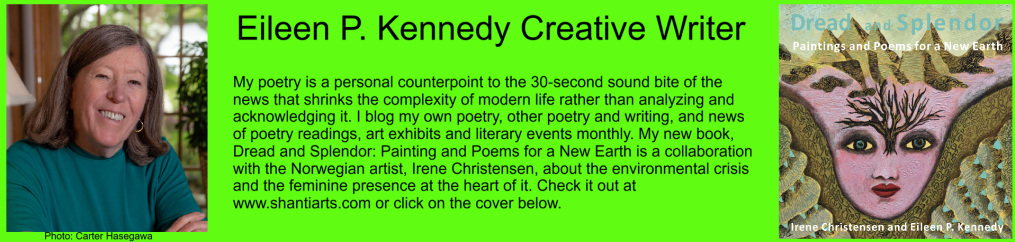
The past two years I have been collaborating with the Norwegian artist, Irene Christensen, pictured on the left above. We met at the Julia and David White Artist Colony in Costa Rica years ago and it was our mutual love of nature and art through the years that eventually led to our collection of eco-poetry and art called Dread and Splendor: Paintings and Poems for a New Earth.

I guess when one artist collaborates with another, it creates an understanding of the other’s artists’ work that wouldn’t have been possible otherwise. Irene created a series of paintings about women at the heart of the environmental movement. I responded to these evocative paintings in the best way I know, through poetry. 

Yesterday. Oil, 16” x 12” by Irene Christensen

I find that the combination of painting and poem together merge and the separate works of art become something new. It’s a way of communicating in art that transcends painting or poem alonge.I responded to Yesterday with a poem called “She Occupies Time,” which begins “no quiet merging with the azure, but an orangesky, the earth bizarre with diasporic life.” 

Irene Christensen, the artist, started exhibiting her paintings with the poems I had written for them. Perilous Journey at the Galleries of the Interchurch Center in New York City. Queen of the Woods was exhibited with poem and painting at the Voices of the Earth Exhibition in Galleri Schaeffers Gate 5, Oslo,Norway. The painting and poem were sold together as that’s what the buyer wanted, the experience of having both the poem and painting together in his home.

The experience of collaborating and supporting each other as writers and artists is an invaluable part of the process. What has your interpersonal journey been like as a writer or artist?

I will be continuing the journey of our manuscript, Dread and Splendor: Paintings and Poems for a New Earth each week on Thursdays. Follow me here.

How to Enhance Your Story

Writing a good story is essential to any genre. Story writing is a key element of being a competent writer.

If you want to be as complete a writer as possible, it is important that you know  how to write a good story. Story writing is a common skill for most writers, it is something that most writers take for granted. In truth, you must develop your writing skills to the best of your abilities.

If you want to reach your full potential as a writer, you will need to tell a truly great story. Before you start writing your story though, you should make sure you know what story writing really is, and what the elements are needed. The five elements of a story are character, plot, setting, conflict and resolution.

Photo by Suzy Hazelwood on Pexels.com

This is simple enough, but how do you make your story stand out?

One way to do this is to have your manuscript reviewed by a more experienced writer. There are many writers you can hire to do this or you can join a writing group. A good writing group will put everyone on an equal footing where everyone reads and the group comments on the piece. This can be done in a generative group, where everyone is writing something new right there and everyone shares or a critique group, where a manuscript, or part of one is sent out in advance by a group member and then the group reads it and offers critique. This route can be more difficult to do than paying a consultant, because you will want to feel comfortable with how the group operates before you can feel the feedback is helpful.

I was writing a collection of eco-poetry because I am passionate about climate justice. Then I met the Norwegian artist, Irene Christensen, who was doing a series of paintings about women at the heart of the environmental movement. We decided to collaborate and came up with a 60-page manuscript called Dread and Splendor: Paintings and Poems for a New Earth.

Another way to improve your story writing skills is to read other stories. I try to read something new on a daily basis. The more you delve into new literature, the more concepts and ideas will find their way into your own story writing.

But the most important thing to remember about being a good writer is to keep at it. A good writer writes everyday. Even if what you’re writing that day is not going well, if you keep at it, you’ll eventually get to something that works. You can’t sit down the first time and tell a wonderful, well-written story. It takes practice.

Follow me here on Thursdays. I will be writing about the writing/publishing process and the progress of my manuscript Dread and Splendor: Paintings and Poems for a New Earth.

On Using the Pause in Your Writing

Photo by Ekaterina Pashkevich on Pexels.com

“How much better it seems now, than when it is finally done. How hungrily one waits to feel the bright lure seized, the old hook bitten.

–Dana Gioia

Writers have been using “the pause” in their writing for a long time. This is a space between writing sessions where the writer breaks off before the piece is finished, and think about the piece in between. Many famous artists used this method from Hemingway to Beethoven. For creatives, it’s a way of keeping going when you know something is unfinished.

This “pause” taps directly into the creative process. Unfinished tasks stay in the psyche and urge the artist to be finished. Hemingway liked to stop in the middle of a sentence. Then he would think about the passage he had left behind until he was able to return to his work.

Artists don’t finish great works in one sitting anyway. Picasso would start multiple paintings at once and pause before each one was finished. Maya Angelou would stop mid-paragraph, if she felt it wasn’t going quite right. Pausing creates a discomfort for the artist. The artist is uncomfortable when the piece is left unfinished and wants to get back to it, maybe after many pauses, and finish it. The pull of the unfinished will bring the artist back to where he/she left off.

The pause is not complicated. It’s not something that requires hours of training or discipline. It’s just the call of the unfinished; the itch that needs to be scratched; the natural calling back to the page.

When I wrote my latest manuscript, Dread and Splendor: Paintings and Poems for a New Earth, it took me two years. It was my first collaborative effort with the Norwegian artist, Irene Christensen. We started the project in Costa Rica, where we had casitas close to each other in an artists colony, but later there were many pauses as we communicated across continents. She met me at my house in Massachusetts and I met her several times in New York City. But most of the reconnecting was done via internet or phone.

The manuscript has now been accepted by two publishers and there will be pauses and reconnecting again as we move forward with our new publisher, Shanti Arts. I will blog on Thursdays. Follow me here.

Publishing In the Best Literary Journals for Poets

Photo by sumit kumar on Pexels.com

Poets like to be published in literary journals, but there are some journals that are considered at the top and most poets would love to be in. Once they’ve got a few publications under their belt, they might have success with one of the following sites. A publication in any of these poetry journals could catapult your writing toward a larger, more reputable audience.

Best American Poetry is an anthology of the best poetry of the year. Each year, this series presents essential American verse and the poets who create it. Truly the “best” American poetry has appeared in this venerable collection for over thirty-five years. Get a copy of this and look at the journals the poems first appeared in. Robert Pinsky, the famous poet and literature professor, has called this annual anthology “a vivid snapshot of what a distinuished poet finds exciting, fresh and memorable.”

Among the literary journals often found the Best American Poetry anthology is The New Yorker, Poetry Magazine, The American Poetry Review, The Southern Review, The New England Review, The Harvard Review, The Cincinnati Review, Prairie Schooner, The Kenyon Review, Southwest Review, The Virginia Review Quarterly, New Ohio Review, the Paris Review, The Nation, The Georgia Review, The American Scholar, AGNI, The Literary Review, The Iowa Review, The Common, The Boston Review, Harper’s, Gulf Coast, Conduit, River Styx, Denver Quarterly, The Atlantic Monthly, Barrow Street, Cave Wall, The Alaska Quarterly Review, The Sun, New York Times Magazine, Black Warrior Review, The Colorado Review, The Carolina Quarterly, The Missouri Review, Pleiades, The New Criterion, The Hopkins Review, Image Magazine, The Southampton Review, The Sewnee Review, Birmingham, Massachusetts Review, The Sycamore Review, Terminus Magazine, Cherry Tree, Ecotone, Crazy Horse, Gulfshore Life, Hayden’s Ferry Review, The Hudson Review, The Iron Horse Literary Review, Naugatuck River Review, Maggy, The Manhattan Review, McSweeney’s, Michigan Quarterly Review, New South, New York Quarterly, PEN America, Poetry London, Poetry Northwest, The Rumpus, Southern Indiana Review, Vinyl Poetry, Buzzfeed, Mississippi Review, Cooper Nickel, Crab Apple Review, Copper Nickel and Brilliant Corners.

I have just signed a contract for a new book, Dread and Splendor: Paintings and Poems for a New Earth, with my artist colleague, Irene Christensen with Shanti Arts Press. It should be out in 2025. I will chronicle this experience to publication here on Thursdays. Follow me here.


Poetry and Online Journals

Photo by Vlada Karpovich on Pexels.com

There are many reasons to submit poetry to literary journals, and online journals are the fastest growing segment. .Some carry prestige because they are well regarded in the literary world.Some have themed issues that may be just what you’re interested in writing about. Some publications pay. 

Duotrope classifies journals into paying and nonpaying publications.There are a wealth of both online and print literary journals and some that do both. If you want to submit a poetry manuscript for publication as a book, publishers will look for acknowledgements of publications in literary journals to see that your book will thrive in the literary marketplace. Some poetry book publishers have literary journals where you can have your poem noticed by a book editor.

Here are just some of the journals published online:

Rising Phoenix Review https://therisingphoenixreview.com/ loves poetry that is “visceral” with “stunning, concrete imagery.” Their tastes lean toward the contemporary, sponsoring poetry that uplifts diverse voices and imagines a better world. This is an example of a journal that is sponsored by a poetry chapbook publisher, Rising Phoenix Press. If you want to publish a book with this press, starting with a publication in their journal is a good way to get to know the publisher.

Rattle ttps://www.rattle.com puts out several popular contests and publication opportunities, including a monthly ekphrastic challenge (a poem in response to a piece of art) , a weekly news-writing challenge, and an annual best poem prize. They are another journal that pays its poem winners, although the payout varies.

Palette Poetry https://www.palettepoetry.com/ publishes new and experienced poets. For experienced poets, they have a previously published poem contest. They are one of the journals that pay for poem winners, and pay well.

Freezeray http://www.freezeraypoetry.com/ specializes in pop culture .publishing. It publishes pieces about social media and is unique in the marketplace.

If you want more suggestions, subscribe to Poets & Writers and use pw.org. They have a listing of most literary journals. Good, publishable poems receive rejections all the time, often because a journal has a finite amount of space to publish each month.

I will be blogging on Thursdays. Follow me here.


Publishing Poetry

Many writers write poetry, even if it’s not their favorite genre.There is not much money in publishing poetry, unless you’re a poet laureate like Billy Collins or famous internationally like Sheamus Heaney.  But there is a market for publishing poetry.

Photo by Ou011eUZHAN YAVUZ on Pexels.com

The best way for a new poet to publish is in a poetry journal or magazine.  Split This Rock offers an online list of literary journals https://www.splitthisrock.org/resources/literary-arts-journals. There are many other websites that show journals looking for poetry. You need to do some homework to figure out with which journals your poetry will resonate.

You may not want to start with well-established journals like The Kenyon Review or The American Poetry Journal, but there are many to choose from.  Starry Starry Kite https://www.lindacastronovo.com/theonlinejournala new online journal, is open to submissions from new writers.

Poetry remains a niche market for bookstores.  A good bookstore carries poetry books (and you should buy some.)  They carry classic poets, academic anthologies, and well-known poets. Most poets don’t reach this level.  If you have a relationship with your local bookstore owner (and you should get to know him/her,) this person is likely to carry a few copies of your new book.  I left three copies of my latest book with a local bookstore, and it sold all three copies, but it took about a year.

Book publishers look at the back of your submitted full-length manuscripts for acknowledgements of poetry published in literary journals.  I’ve heard that some publishers look for a 25 percent ratio of published poems to 75 percent nonpublished when looking at a book manuscript.  This percentage will vary publisher to publisher, but the publisher wants to know the poems in the manuscript were considered publishable by the literary journals.

Each journal has its own submission procedures, but as a rule, they don’t want more than five or six poems per submission.  Rejections are more common than not, so be prepared for this.  You should get an idea of what the journal is publishing by looking online at poetry from that journal, going to your local library and looking at old issues, or just buying a sample issue.  A good sponsor for a good journal is a university, so check the journal’s affiliations. If you like the poetry the journal offers, it’s a good sign that the journal might like your poetry.

I published in about 25 literary journals, including Nebo, The California Quarterly, Taproot Literary Quarterly and Crosswinds Literary Journal, before I published my first book of poetry. 


I chose to submit to small, independent publishers who were known to publish new poets.


I have a new manuscript, Dread and Splendor: Paintings and Poems for a New Earth, out for consideration with a few small independent publishers.  This is my first collaborative manuscript with the Norwegian artist, Irene Christensen.  She did a series of paintings about women at the heart of the environmental movement for which I wrote poem responses.  This is specialized publishing as the publisher needs to be experienced with four-color visuals as well as poetry. I don’t know if this will get published, but we never know for sure as poets.

I will be blogging on Thursdays. Follow me here.

I’m Delighted The Orange & Bee Is Publishing My Twin Poem “Fairy Tale of Eternal Economic Growth”

I’m delighted to have my poem, “Fairy Tale of Eternal Economic Growth” published in the September 27, 2024 issue of The Orange and Bee. I’ve attached a link to it below if you want to read it.


The submission is a twin poem, which means the two columns can be read down or across.I drew on the Norse Folk Tales of Greta Thunberg’s Scandinavian heritage.  Odin had two wolves, Geri and Freki.  Geri was interpreted as the greedy one and Freki the avaricious one.  I think wolves are a good symbols of the corporate greed that Thunberg argues against. The visual they use with the poem is Greta Thunberg’s photo as a child.

Photo by Balpreet Singh on Pexels.com

The Orange & Bee publishes original and contemporary short stories, poems, and essays that explore, expand on, and subvert the rich traditions of international folklore, with a strong focus on fairy tales (though they also sometimes dabble in other forms of folklore, such as fables, myths, and legends). They also publish traditional tales accompanied by annotations, discussion questions, and writing prompts. Their real mission is to build a community—a virtual salon—around shared passion for fairy tales.

See the poem and photo of Greta Thunberg here:

https://theorangebee.substack.com/p/4523ca2d-ab6b-4812-b67e-7a157178cdeb

I am writing much eco-poetry these days, about the environmental crisis. I compiled a manuscript of poems and paintings, with the Norwegian artist, Irene Christensen, called Dread and Splendor: Paintings and Poems for a New Earth. It’s a book about women at the heart of the environmental movement. I will blog on Thursdays. Follow me here.

On Blogging

Photo by Pixabay on Pexels.com

A blog is a website where you can share your thoughts, ideas, and experiences with the world.

You canuse a blog to promote your business, connect with like-minded people, and make money. I’m a writer and I use it to promote writing: other writers and my own.A blog is a website where people can post their thoughts and opinions on a variety of topics. A blog is an online journal where you can share your expertise and ideas. 

Blogs started out as diaries, but they have evolved into much as most bloggers are now earning a full-time income from their blogs. I don’t aspire to making money with my blog, but some people do. I like to blog about the writing process and that’s the subject of this blog: the process, publishing, promoting.

I use WordPress here and more than 70 million posts are published each month by WordPress users. That’s a lot of blogs. I focus on the literary ones, but you can look for all kinds of topics and write one yourself if you’re interested. Blogs have been rated as the fifth most trustworthy source for gathering online information. More than 75 percent of internet users read blogs. That’s a lot of blog readers.

If you’re interested, you can start a blog on WordPress for free. When you publish a book, many publishers will want the link to your blog as a writer. Blog posts are written in a more informal way when compared to traditional academic articles. If you’re a writer, it’s easy to blog. Just sign up for a free blog site and start writing about what you’re doing as a writer. Blogs have an informal approach.

Blogs are organized in reverse chronological order, with the newest blog post appearing at the top. Websites can have a variety of structures, depending on their purpose.
A blog often has a conversational tone, whereas most websites use a formal writing tone. They are interactive as they allow reader engagement, such as commenting, social sharing buttons, etc., which websites do not. Also, a blog is updated continuously, a website may or may not be updated.

If you are interested in blogging, and many writers and artists are, by all means get started with a free carrier like WordPress. I will be blogging here on Thursdays. Follow me.

How to Publish Poetry

Photo by Mathias Reding on Pexels.com

There is a large poetry market for individual poems and whole manuscripts.

Literary journals publish many poems and some publishers publish poetry books. Poetry remains a niche market for bookstores.  A good bookstore carries poetry books (and you should buy some.)  They carry classic poets, academic anthologies, and well-known poets. Most poets don’t reach this level.  If you have a relationship with your local bookstore owner (and you should get to know him/her,) this individual is likely to carry a few copies of your new book.  I left three copies of my latest book with a local bookstore, and it sold all three copies, but it took about a year.

The best way for a new poet to publish is in a poetry journal or magazine.  Split This Rock offers an online list of literary journals https://www.splitthisrock.org/resources/literary-arts-journals.

You need to do some homework to figure out with which journals your poetry will resonate and want whatever poetry you have to offer.

You may not want to start with well-established journals like The Kenyon Review or The American Poetry Journal, but there are many to choose from.  Starry Starry Kite https://www.lindacastronovo.com/theonlinejournala new online journal, is open to submissions of poetry.

Publication in literary journals is also important to book publishers.  I’ve heard that some publishers look for a 25 percent ratio of published poems to 75 percent nonpublished when looking at a book manuscript.  This percentage will vary publisher to publisher, but the publisher wants to know the poems in the manuscript were considered publishable by the literary journals.

In nearly all cases, these book publishers will only publish a new poet if they have a track record with the literary journals.

Each journal has its own submission procedures, but as a rule, they don’t want more than five or six poems per submission.  Rejections are more common than not, so be prepared for this.  You should get an idea of what the journal is publishing by looking online at poetry from that journal going to your local library and looking at old issues, or just buying a sample issue.  A good sponsor for a good journal is a university, so check the journal’s affiliations. If you like the poetry the journal offers, it’s a good sign that the journal might like your poetry. Read the journal’s submission guidelines carefully.

I published in about 25 literary journals, including Nebo, The California Quarterly, Taproot Literary Quarterly and Crosswinds Literary Journal, before I published my first book of poetry. 

I chose to submit to small, independent publishers who were known to publish new poets.

I have a new manuscript, Dread and Splendor: Paintings and Poems for a New Earth, out for consideration with a few small independent publishers.  This is my first collaborative manuscript with the Norwegian artist, Irene Christensen.  She did a series of paintings about women at the heart of the environmental movement for which I wrote poem responses.  This is specialized publishing as the publisher needs to be experienced with four-color visuals as well as poetry. I don’t know if this will get published, but we never know for sure as poets.

Follow me here on Thursdays where I will blog about writing, the writing process, editing, revising and publishing.