
Starting the Writing Process

Photo by Photo By: Kaboompics.com on Pexels.com

Whether you’ve had six books published or you are a new writer, getting started can be a challenge. Writing is a process, not merely a product. The quality of your writing will be reflected in the thought and time you put into it.

Having a deadline can be helpful. If you have an editor waiting for your final draft or you have an assignment due, this is a motivation. If you don’t, you can set one for yourself. I often do.

Planning ahead is a good place to start. Sn outline is even better. You don’t have to actually write, you can just think about what you want to say and plan ahead. When you do sit down to it, you’re that much ahead. Then schedule a few writing sessions. That way if you’re not feeling like it, or if you want some revising time, you can return to it later. I rarely finish a piece in one sitting.

Topic and audience are often interrelated. Think about what you want to say to your audience and how that informs your topic. Ask yourself who the audience is, Why is your audience interested in this topic and what do they already know, if anything, about it. What of you think your audience would/should gain from your text?

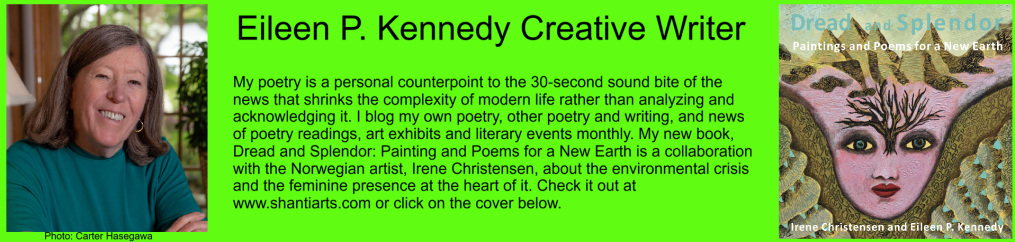
Think about the purpose of your writing. Why are you writing the piece My most recent book, a collaboration with the Norwegian artist, Irene Christensen, was inspired by her paintings about women at the heart of the environmental movement. It’s called Dread and Splendor: Paintings and Poems for a New Earth. I wanted to respond poetically to Irene’s work, but I also wanted this to raise awareness of the environmental crisis.

My new book will be out in early 2026 from Shanti Arts. I will keep you apprised of the publishing process on it. Follow me here monthly.

Writing in a Foreign Country

Photo by Kevin Malik on Pexels.com

If you are a writer, you write. Even if you’re traveling or just put down for awhile in a new place. I find traveling stimulating for my imagination and a natural time to write, even if it’s just in a travel journal.

For about the past twenty years, I have been spending winter in Costa Rica, where mostly I writeThe change of location seems to effect my writing in a positive way. Travel brings new experiences and ideas to you that will show up in your writing.

The travel can be anywhere: the next town to another country. I just don’t like winters in the Northeast, where I normally live, so I like traveling in warmer climbs in the winter months. I’ve traveled in the winter in Mexico too. I mostly write while I’m here. i devised the manuscript for my upcoming book: Dread and Splendor: Paintings and Poems for a New Earth here.

I find the change of scene helps my writing in several ways. First of all, whether I’m in a hotel or temporary apartment, I don’t worry about cleaning or answering mail (which I have held.) I focus more on my writing. Also, you don’t tend to be on the phone with telemarketers or even friends. 

Then there is just the stimulation of being someplace different, with a different language, culture, sights. This may lead to a whole opening up of your writing to new topics.

You can add new language to your writing. A noun or two in Italian or Spanish can add to the authenticity of your poem or story. But be careful about using too much that a non-Spanish or non-Italian speaker may find confusing. You can offer your reader context cues and nonverbal communication to help understanding. You can also italicize the foreign word to distinguish it from the English.

You can also set your next piece in the country your visiting. I’ve often written poems about Costa Rica. The sights and smells of the country will permeate your writing. It’s a much better way of learning about it then researching online or in a library. Talk to as many locals as possible. Introduce yourself as a writer and explain that you are working on a story set in that country. This will help open up people to answer your questions.

Read other books set in that country and google it. Read blogs, articles, travel articles, news. Learn as much as you can about the country.

Finally, talk to your accountant. You may be able to write off your travels to your writing business. I am publishing a book, Dread and Splendor: Paintings and Poems for a New Earth early next year with Shanti Arts. It’s a book that was hatched by myself and an artist, Irene Christensen, on one of my visits to Costa Rica. The book, which has some poems and paintings about Costa Rica, would not have existed unless I had made that trip to Costa Rica.

I will be blogging monthly about the writing process and my new book. Follow me here on Thursdays.

On Using the Pause in Your Writing

Photo by Ekaterina Pashkevich on Pexels.com

“How much better it seems now, than when it is finally done. How hungrily one waits to feel the bright lure seized, the old hook bitten.

–Dana Gioia

Writers have been using “the pause” in their writing for a long time. This is a space between writing sessions where the writer breaks off before the piece is finished, and think about the piece in between. Many famous artists used this method from Hemingway to Beethoven. For creatives, it’s a way of keeping going when you know something is unfinished.

This “pause” taps directly into the creative process. Unfinished tasks stay in the psyche and urge the artist to be finished. Hemingway liked to stop in the middle of a sentence. Then he would think about the passage he had left behind until he was able to return to his work.

Artists don’t finish great works in one sitting anyway. Picasso would start multiple paintings at once and pause before each one was finished. Maya Angelou would stop mid-paragraph, if she felt it wasn’t going quite right. Pausing creates a discomfort for the artist. The artist is uncomfortable when the piece is left unfinished and wants to get back to it, maybe after many pauses, and finish it. The pull of the unfinished will bring the artist back to where he/she left off.

The pause is not complicated. It’s not something that requires hours of training or discipline. It’s just the call of the unfinished; the itch that needs to be scratched; the natural calling back to the page.

When I wrote my latest manuscript, Dread and Splendor: Paintings and Poems for a New Earth, it took me two years. It was my first collaborative effort with the Norwegian artist, Irene Christensen. We started the project in Costa Rica, where we had casitas close to each other in an artists colony, but later there were many pauses as we communicated across continents. She met me at my house in Massachusetts and I met her several times in New York City. But most of the reconnecting was done via internet or phone.

The manuscript has now been accepted by two publishers and there will be pauses and reconnecting again as we move forward with our new publisher, Shanti Arts. I will blog on Thursdays. Follow me here.

The Writer’s Notebook

Every writer should keep a notebook or journal. A stray piece of paper wouldn’t do. I have always had a notebook, but I have been using my iPhone as a notebook these last few years. I find that I lose my notebook, but always have my phone. You can also use apps, such as My Journal. I was thinking about the long relationship that I’ve had with notebooks, and their centrality to everything I do, the way that they foster my creativity across years and decades.

I’m sure that’s true of most other writers. And yet, whenever I see guides to keeping a journal online, I rarely recognise my own practice in there. I’ve seen so many idealised journals, designed for public display, written in overly neat handwriting using multi-coloured pens, filled with motivational quotes and orderly bullet points. This kind of journal feels wrong to me, reeking of an overly disciplined school: the people-pleasing, self-conscious, high-pressure spaces of my school books. The tyranny of good presentation and legibility.

Photo by Ayush Meshram on Pexels.com

In my view, a notebook should be unorganized. It should be random thoughts that you want to pick up later. I’ve written many poems from random thoughts I’ve had a movies, while reading, while listening to music, or just going to the supermarket.

Your notebook should be written for nobody’s eyes but your own. It’s a completely private space, where you are the only one writing and reading. You should never show anything directly from its pages, and certainly don’t let anyone have a flick through. This gives you the freedom to write anything in it That might be my darkest thoughts or my fragile feelings; but mostly it’s just terrible writing. Be incoherent, self-pitying, tacky, boring or stupid in this space. It’s nobody else’s business.

I’ll be taking a break from blogging for the month of August. Follow me here again on Thursdays after Labor Day.

Sometimes We Have to Gather Tomatoes to Write

I plant tomatoes every spring

Their small green selves

Growing shockingly tall

And flashing yellow flowers

That turn to rich red fruit

Juicy as I pop them in my mouth

Photo by Julia Nagy on Pexels.com

I wrote this on a winter’s day longing for summer and its fruit and vegetables.

This blog is intended for the part of you that is longing for a moment in the sultry sun.

Can you feel the fresh breezes coming?

Remember the time you bought tomatoes at a roadside stand. You ate them all by yourself or with a lover or a friend.

In order to write, take your shoes off, get rid of your bags, and all the items that keep interrupting your experience in this summer moment.

Recall some happy summer, some years ago, when you did this sort of thing.

If you do this sort of thing and poems will happen because of it. We need time and space for reflection.

Visit me here on Thursdays when I will blog about the writing process, poetry and publishing.

Meditating and Writing

Photo by Prasanth Inturi on Pexels.com

Many writers are also meditators. Some even write about the relationship between writing and mediation. I am a meditator and a writer. I meditate in the morning and write in the morning. I also practice yoga. To me, these are all intertwined.

The U.S. alone has an estimated 36 million yoga practitioners. It has adapted to local socio-political and cultural norms world over so much so that it can hardly be called an Indian custom. Yoga originated in India. The system of yoga has physical, mental, and emotional dimensions in addition to spiritual underpinnings. But yoga is not a religion. It has no dogma. But the practice for me is essential to my writing and brings me to a place where I can write truth.

Meditation helps improve focus. Something essential for the good writer. I began meditating years ago with a meditation method popular at that time, Transcendental Meditation. Maharishi Mahesh Yogi developed this mantric method of meditation in the 50’s in India, and it spread widely throughout the world. For me, it was a good place to learn the technique, but my meditation practice evolved when I combined meditation with yoga, especially Kundalini. Kundalini is a spiritual energy or life force located at the base of the spine, conceptualized as a coiled serpent. It didn’t matter which type of meditation I was using, as long as it focused my mind and enabled me to write from that place.

Meditation provides a safe space to be. Meditation slows the world down to make room for creative thought and exploration. It’s an ideal practice for the writer or artist. I meditated every day when I worked on my latest manuscript, Dread and Splendor: Paintings and Poems for a New Earth.

Have you had experiences with writing and meditation?

I will be taking a hiatus for March, as I travel through Costa Rica. Look for me again in April.

Writing and Bloom’s Taxonomy

Photo by Mariya on Pexels.com

As a career educator, I often used Bloom’s Taxonomy. I taught little ones on the elementary school level, and then college students. I always encouraged my students to approach study using this six-step process.

The model was named for Benjamin Bloom, who first came up with it. It has six levels:

  1. Knowledge
  2. Comprehension
  3. Application
  4. Analysus
  5. Synthesis
  6. Evaluation

I think Bloom’s Taxonomy can be applied to writing. You may come across an idea for your writing and research the topic and comprehend it. Then you can apply it in your writing. In the analysis phase you break down complex ideas about what you’re writing. In the synthesis part you combine the ideas you have generated in the process and make it original, or your own.

Finally in evaluation, you make judgments about the value of what you have created and decide if it is something you want to pursue. As writers, we have all written things we don’t think work, but even if you don’t come out with something good after this process, it’s bound to lead to something worth using later. Nothing is ever wasted in the creative process.

I will be take a hiatus from blogging for the summer, but will be back blogging on Thursdays in September. Have a great summer and look for me here in the fall.

Writing and Journaling

I have been keeping a journal for years. I’m often not at my laptop when I have an idea, so I journal on my iPhone. I always have my IPhone near by, as most people do. A piece of writing begins with a germ of an idea, an inspiration, a thought. Some people use their journals to spark ideas.

Photo by Jessica Lewis Creative on Pexels.com

In addition to being a good starting point for a writer, journaling has other benefits. According to LeslieAndrus-Hacia, a clinical psychiatrist says “writing is a brain-based porthole leading to a balanced and calm state of being … through writing, both right-and left-brain hemispheres communicate, synthesizing information that ultimately results in greater mental coherence.”* Other benefits of journaling include memory support and increasing communication skills.

I published a collection of poems on Alzheimer’s Disease and Dimentia. Many were from thoughts in my journal.

Check it out:

https://www.finishinglinepress.com/product/touch-my-head-softly-by-eileen-kennedy/

Follow me here on Thursdays.

On Writing and Depression from Leonard Cohen

Photo by Andre Moura on Pexels.com

I speak of a clinical depression that is the background of your entire life, a background of anguish and anxiety, a sense that nothing goes well, that pleasure is unavailable and all your strategies collapse. –Leonard Cohen

This quote from Leonard Cohen certainly mirrors my own feelings from time to time, especially about writing. The world often seems chaotic these days. So how do you write through it?

A writer can feel stuck when depressed. Being on a roll and suddenly having the creative juices dry up is something all creative people experience. Watching your process slowly break down until you are at a standstill. Staring at the blank page. You try to write your way out of it, but you hate every word. It connects to a larger phenomenon of lacking ideas or any endeavor that requires creativity.

Stephen King advises the “write yourself out of it” approach. Many writers believe the words we put down are indeed worthless and not worth the time. They fear ruining the piece. But the reality is sometimes we just need to write through the dry periods. Like athletes doing practice drills, we just have to keep at it until the good material comes back. If we don’t keep writing, we won’t be at our computers when the good stuff comes.

While much of writer’s block is steeped in depression, there are all sorts of other challenges that impact writing as well. Physical health, mental health, and emotional health can affect performance across. If you are struggling with depression, you might still be able to write like always, just as people with depression can joke with their friends or go through the motions at writing even though they are struggling inside.

Leonard Cohen, who suffered from depression, was certainly a model for “writing through it.” He was in the middle of composing a poem when he died. I like to think of that when I get discouraged with my writing.

I will be blogging on Thursdays. Follow me here.