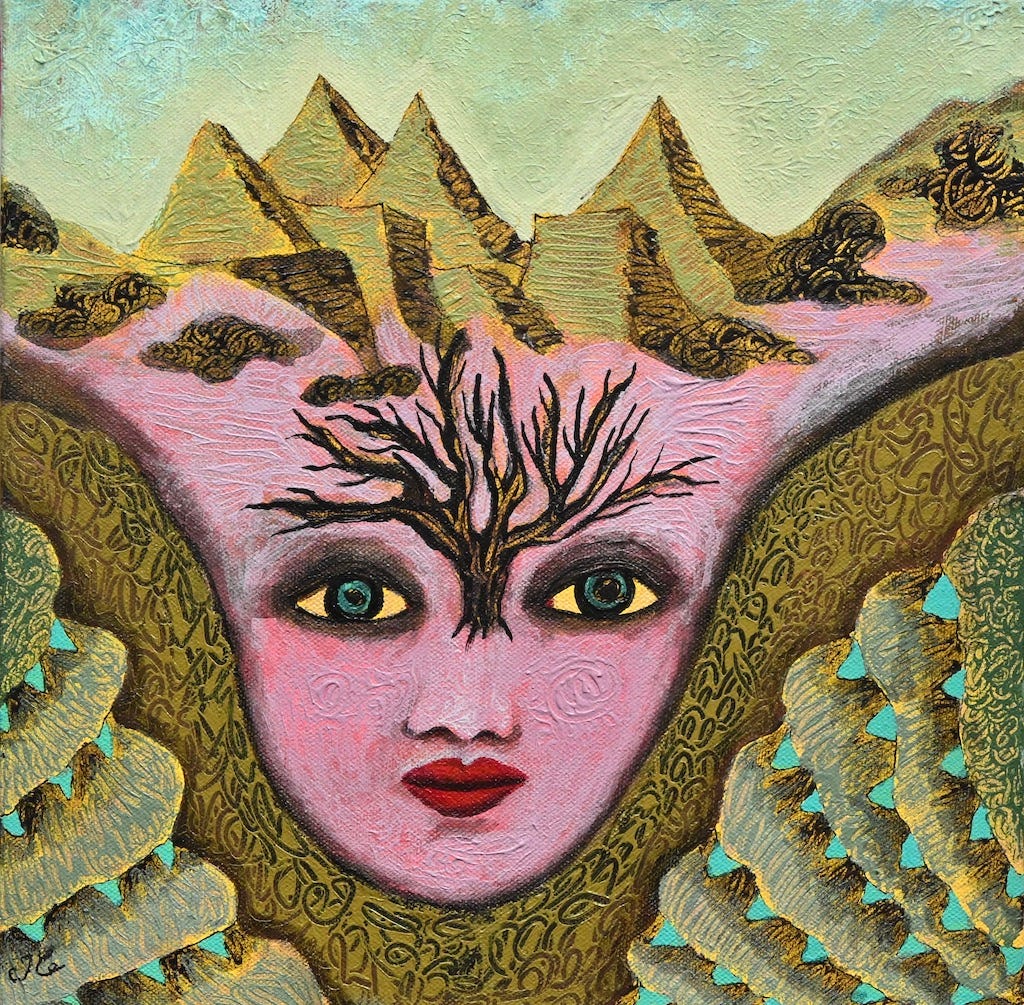
I have been working on this manuscript for some time with the Norwegian Artist, Irene Christensen. The painting seen here, “The Goddess Speaks,” is a candidate for the cover art. There are more than 30 full-color paintings, many oil, that inspired my poems.
It was a challenge finding a publisher who wanted to publish the book because the four-color art is more expensive to produce than the average poetry collection. Not many publishers even publish visuals with poetry. The final cost of the book will be more thatn the average poetry book. We wound up submitting simultaneously to four publishers, and getting offers from two, Finishing Line Press and Shanti Arts. We decided to go with Shanti Arts.
For those of you who follow my blog, you have been with me on my journey to publication of this manuscript. It was important to me to publish this manuscript as it’s a complete collection of eco-poems, inspired by the paintings of women at the heart of the movement to preserve the environment. Like recycling and going with green energy, as an artist, I wanted to contribute to the literature on the environmental crisis.
I didn’t even want to tell people about my upcoming book publication until I had a signed contract. Now I do. The next step is refining the accepted manuscript and making it the best it can be. I rely on my writer friends to read and make suggestions. I don’t always use these suggestions, but it helps to have another pair of eyes looking at my poems and suggesting what’s strong and what’s stopped them as they were reading.
For those of you who followed my blog through the development of this manuscript, my first collaborative effort with an artist, continue to follow me though the final steps before publication and beyond.
I will blog about the publication process each week. Follow me here.
Poets like to be published in literary journals, but there are some journals that are considered at the top and most poets would love to be in. Once they’ve got a few publications under their belt, they might have success with one of the following sites. A publication in any of these poetry journals could catapult your writing toward a larger, more reputable audience.
Best American Poetry is an anthology of the best poetry of the year. Each year, this series presents essential American verse and the poets who create it. Truly the “best” American poetry has appeared in this venerable collection for over thirty-five years. Get a copy of this and look at the journals the poems first appeared in. Robert Pinsky, the famous poet and literature professor, has called this annual anthology “a vivid snapshot of what a distinuished poet finds exciting, fresh and memorable.”
Among the literary journals often found the Best American Poetry anthology is The New Yorker, Poetry Magazine, The American Poetry Review, The Southern Review, The New England Review, The Harvard Review, The Cincinnati Review, Prairie Schooner, The Kenyon Review, Southwest Review, The Virginia Review Quarterly, New Ohio Review, the Paris Review, The Nation, The Georgia Review, The American Scholar, AGNI, The Literary Review, The Iowa Review, The Common, The Boston Review, Harper’s, Gulf Coast, Conduit, River Styx, Denver Quarterly, The Atlantic Monthly, Barrow Street, Cave Wall, The Alaska Quarterly Review, The Sun, New York Times Magazine, Black Warrior Review, The Colorado Review, The Carolina Quarterly, The Missouri Review, Pleiades, The New Criterion, The Hopkins Review, Image Magazine, The Southampton Review, The Sewnee Review, Birmingham, Massachusetts Review, The Sycamore Review, Terminus Magazine, Cherry Tree, Ecotone, Crazy Horse, Gulfshore Life, Hayden’s Ferry Review, The Hudson Review, The Iron Horse Literary Review,Naugatuck River Review, Maggy, The Manhattan Review, McSweeney’s, Michigan Quarterly Review, New South, New York Quarterly, PEN America, Poetry London, Poetry Northwest, The Rumpus, Southern Indiana Review, Vinyl Poetry, Buzzfeed, Mississippi Review, Cooper Nickel, Crab Apple Review, Copper Nickel and Brilliant Corners.
I have just signed a contract for a new book, Dread and Splendor: Paintings and Poems for a New Earth, with my artist colleague, Irene Christensen with Shanti Arts Press. It should be out in 2025. I will chronicle this experience to publication here on Thursdays. Follow me here.
This poem and painting is part of the upcoming book Dread and Splendor: Paintings and Poems for a New Earth, to be published by Shanti Arts Press in 2025.
There are many reasons to submit poetry to literary journals, and online journals are the fastest growing segment. .Some carry prestige because they are well regarded in the literary world.Some have themed issues that may be just what you’re interested in writing about. Some publications pay.
Duotrope classifies journals into paying and nonpaying publications.There are a wealth of both online and print literary journals and some that do both. If you want to submit a poetry manuscript for publication as a book, publishers will look for acknowledgements of publications in literary journals to see that your book will thrive in the literary marketplace. Some poetry book publishers have literary journals where you can have your poem noticed by a book editor.
Here are just some of the journals published online:
Rising Phoenix Reviewhttps://therisingphoenixreview.com/ loves poetry that is “visceral” with “stunning, concrete imagery.” Their tastes lean toward the contemporary, sponsoring poetry that uplifts diverse voices and imagines a better world. This is an example of a journal that is sponsored by a poetry chapbook publisher, Rising Phoenix Press. If you want to publish a book with this press, starting with a publication in their journal is a good way to get to know the publisher.
Rattle ttps://www.rattle.com puts out several popular contests and publication opportunities, including a monthly ekphrastic challenge (a poem in response to a piece of art) , a weekly news-writing challenge, and an annual best poem prize. They are another journal that pays its poem winners, although the payout varies.
Palette Poetryhttps://www.palettepoetry.com/ publishes new and experienced poets. For experienced poets, they have a previously published poem contest. They are one of the journals that pay for poem winners, and pay well.
Freezerayhttp://www.freezeraypoetry.com/ specializes in pop culture .publishing. It publishes pieces about social media and is unique in the marketplace.
If you want more suggestions, subscribe to Poets & Writers and use pw.org. They have a listing of most literary journals. Good, publishable poems receive rejections all the time, often because a journal has a finite amount of space to publish each month.
Many writers write poetry, even if it’s not their favorite genre.There is not much money in publishing poetry, unless you’re a poet laureate like Billy Collins or famous internationally like Sheamus Heaney. But there is a market for publishing poetry.
Photo by Ou011eUZHAN YAVUZ on Pexels.com
The best way for a new poet to publish is in a poetry journal or magazine. Split This Rock offers an online list of literary journals https://www.splitthisrock.org/resources/literary-arts-journals. There are many other websites that show journals looking for poetry. You need to do some homework to figure out with which journals your poetry will resonate.
You may not want to start with well-established journals like The Kenyon Review or The American Poetry Journal, but there are many to choose from. Starry Starry Kite https://www.lindacastronovo.com/theonlinejournal, a new online journal, is open to submissions from new writers.
Poetry remains a niche market for bookstores. A good bookstore carries poetry books (and you should buy some.) They carry classic poets, academic anthologies, and well-known poets. Most poets don’t reach this level. If you have a relationship with your local bookstore owner (and you should get to know him/her,) this person is likely to carry a few copies of your new book. I left three copies of my latest book with a local bookstore, and it sold all three copies, but it took about a year.
Book publishers look at the back of your submitted full-length manuscripts for acknowledgements of poetry published in literary journals. I’ve heard that some publishers look for a 25 percent ratio of published poems to 75 percent nonpublished when looking at a book manuscript. This percentage will vary publisher to publisher, but the publisher wants to know the poems in the manuscript were considered publishable by the literary journals.
Each journal has its own submission procedures, but as a rule, they don’t want more than five or six poems per submission. Rejections are more common than not, so be prepared for this. You should get an idea of what the journal is publishing by looking online at poetry from that journal, going to your local library and looking at old issues, or just buying a sample issue. A good sponsor for a good journal is a university, so check the journal’s affiliations. If you like the poetry the journal offers, it’s a good sign that the journal might like your poetry.
I published in about 25 literary journals, including Nebo, The California Quarterly, Taproot Literary Quarterly and Crosswinds Literary Journal, before I published my first book of poetry.
I chose to submit to small, independent publishers who were known to publish new poets.
I have a new manuscript, Dread and Splendor: Paintings and Poems for a New Earth, out for consideration with a few small independent publishers. This is my first collaborative manuscript with the Norwegian artist, Irene Christensen. She did a series of paintings about women at the heart of the environmental movement for which I wrote poem responses. This is specialized publishing as the publisher needs to be experienced with four-color visuals as well as poetry. I don’t know if this will get published, but we never know for sure as poets.
I’m delighted to have my poem, “Fairy Tale of Eternal Economic Growth” published in the September 27, 2024 issue of The Orange and Bee. I’ve attached a link to it below if you want to read it.
The submission is a twin poem, which means the two columns can be read down or across.I drew on the Norse Folk Tales of Greta Thunberg’s Scandinavian heritage. Odin had two wolves, Geri and Freki. Geri was interpreted as the greedy one and Freki the avaricious one. I think wolves are a good symbols of the corporate greed that Thunberg argues against. The visual they use with the poem is Greta Thunberg’s photo as a child.
The Orange & Bee publishes original and contemporary short stories, poems, and essays that explore, expand on, and subvert the rich traditions of international folklore, with a strong focus on fairy tales (though they also sometimes dabble in other forms of folklore, such as fables, myths, and legends). They also publish traditional tales accompanied by annotations, discussion questions, and writing prompts. Their real mission is to build a community—a virtual salon—around shared passion for fairy tales.
I am writing much eco-poetry these days, about the environmental crisis. I compiled a manuscript of poems and paintings, with the Norwegian artist, Irene Christensen, called Dread and Splendor: Paintings and Poems for a New Earth. It’s a book about women at the heart of the environmental movement. I will blog on Thursdays. Follow me here.
There is a large poetry market for individual poems and whole manuscripts.
Literary journals publish many poems and some publishers publish poetry books. Poetry remains a niche market for bookstores. A good bookstore carries poetry books (and you should buy some.) They carry classic poets, academic anthologies, and well-known poets. Most poets don’t reach this level. If you have a relationship with your local bookstore owner (and you should get to know him/her,) this individual is likely to carry a few copies of your new book. I left three copies of my latest book with a local bookstore, and it sold all three copies, but it took about a year.
You need to do some homework to figure out with which journals your poetry will resonate and want whatever poetry you have to offer.
You may not want to start with well-established journals like The Kenyon Review or The American Poetry Journal, but there are many to choose from. Starry Starry Kite https://www.lindacastronovo.com/theonlinejournal, a new online journal, is open to submissions of poetry.
Publication in literary journals is also important to book publishers. I’ve heard that some publishers look for a 25 percent ratio of published poems to 75 percent nonpublished when looking at a book manuscript. This percentage will vary publisher to publisher, but the publisher wants to know the poems in the manuscript were considered publishable by the literary journals.
In nearly all cases, these book publishers will only publish a new poet if they have a track record with the literary journals.
Each journal has its own submission procedures, but as a rule, they don’t want more than five or six poems per submission. Rejections are more common than not, so be prepared for this. You should get an idea of what the journal is publishing by looking online at poetry from that journal going to your local library and looking at old issues, or just buying a sample issue. A good sponsor for a good journal is a university, so check the journal’s affiliations. If you like the poetry the journal offers, it’s a good sign that the journal might like your poetry. Read the journal’s submission guidelines carefully.
I published in about 25 literary journals, including Nebo, The California Quarterly, Taproot Literary Quarterly and Crosswinds Literary Journal, before I published my first book of poetry.
I chose to submit to small, independent publishers who were known to publish new poets.
I have a new manuscript, Dread and Splendor: Paintings and Poems for a New Earth, out for consideration with a few small independent publishers. This is my first collaborative manuscript with the Norwegian artist, Irene Christensen. She did a series of paintings about women at the heart of the environmental movement for which I wrote poem responses. This is specialized publishing as the publisher needs to be experienced with four-color visuals as well as poetry. I don’t know if this will get published, but we never know for sure as poets.
Follow me here on Thursdays where I will blog about writing, the writing process, editing, revising and publishing.
Every writer should keep a notebook or journal. A stray piece of paper wouldn’t do. I have always had a notebook, but I have been using my iPhone as a notebook these last few years. I find that I lose my notebook, but always have my phone. You can also use apps, such as My Journal. I was thinking about the long relationship that I’ve had with notebooks, and their centrality to everything I do, the way that they foster my creativity across years and decades.
I’m sure that’s true of most other writers. And yet, whenever I see guides to keeping a journal online, I rarely recognise my own practice in there. I’ve seen so many idealised journals, designed for public display, written in overly neat handwriting using multi-coloured pens, filled with motivational quotes and orderly bullet points. This kind of journal feels wrong to me, reeking of an overly disciplined school: the people-pleasing, self-conscious, high-pressure spaces of my school books. The tyranny of good presentation and legibility.
In my view, a notebook should be unorganized. It should be random thoughts that you want to pick up later. I’ve written many poems from random thoughts I’ve had a movies, while reading, while listening to music, or just going to the supermarket.
Your notebook should be written for nobody’s eyes but your own. It’s a completely private space, where you are the only one writing and reading. You should never show anything directly from its pages, and certainly don’t let anyone have a flick through. This gives you the freedom to write anything in it That might be my darkest thoughts or my fragile feelings; but mostly it’s just terrible writing. Be incoherent, self-pitying, tacky, boring or stupid in this space. It’s nobody else’s business.
I’ll be taking a break from blogging for the month of August. Follow me here again on Thursdays after Labor Day.
Everyone, no matter their level of success in life, struggles with their inner critic.
The negative voice tells lies to keep you safe. It’s your brain’s defense mechanism against danger.
Anxiety acts as a guardian angel. Its intentions are pure, but we all know the road to hell is paved with good intentions.
When it comes to life or death situations, your anxiety protects you. But in the trenches of day to day modern life, we rarely encounter a life or death situation that warrants such an extreme measure. Anxiety acts like a guardian, but it can cause us to not act.
Learning to reframe your anxiety is important, so it doesn’t get in the way of your writing.Because the inner critic isn’t objective, whenever you find yourself at conflict with it.
Try to imagine the good that could come out of your writing. Even if what you write today doesn’t turn into something you can use, it is an exercise toward good writing in the end. Think of yourself as an athlete who has to practice before he/she gets really good. Your inner narrator should keep you grounded without discouraging you from moving forward. Don’t silence your inner critic. Think of it as a way to go in the opposite direction of what it wants you to do.
Turn the negative self-talk into an empowering message. Every time you hear yourself thinking that you’re not good enough, that your negative traits are far too many, that it’s not worth it, that it’s not fair, you tell yourself that it’s not so.
After all, the inner critic is kind of dumb, far from objective, and even though its intentions are good, it won’t help you get to where you want to go.
Anxiety, negative self talk, self-doubt should act as triggers to turn them into something that empowers you.
Charles Bukowski almost didn’t become the writer he had always dreamt of being. He worked in a post-office until his fifties, even though he tried and often failed to earn enough from his writing so he could quit his job.
Abraham Lincoln failed time and time again. He lost his bid for State Legislature when he was 23 years old. Six years later, he lost his bid to become Speaker in the Illinois House of Representatives.In 1848, at the age of 39, Lincoln failed to become Commissioner of the General Land Office in D.C. Ten years later, he failed to become a U.S. Senator.
If we try, we might fail. If we give it our all, we might fail. Sometimes I do believe the universe tests our commitment, and I often find that the people who try and fail, never, ever want to try again.
So, what’s the trick?
Follow your heart and intuition. There’s a dream hidden somewhere inside a drawer of your soul you rarely open.
“Do or do not, there is no try.” – Yoda
This is one of those clever quotes that get passed around quite often. When it’s do or die, most people tend to do.
Sometimes we don’t have to step outside our comfort zone. Sometimes we don’t have to take massive action in order to reach a certain goal.
Have you ever chosen not to do something because you were absolutely certain you’d fail?You were so sure you couldn’t, so you didn’t even try.
Doing the impossible will often lead to failure. But if we aim to do the bit that’s possible, if we just give it a try, then we might surprise ourselves by becoming good enough to do what we previously thought of as impossible.
The obvious paradox is that you never know if something’s impossible or not unless you try.Our attitude always determines our altitude in life. When we think we can’t do something, there’s no reason to even try.
It’s better to try something than to give up without even attempting just because you believe that you must do it.
Edison’s famous invention of the light bulb stands testimony to just how powerful such a mindset is. The trick that allowed him to persevere until successful was that he re-framed his failures as, “finding ways that don’t work.”
You, like Edison, you could try to do it before you can decide if it can or can’t be done.
First you want to structure your raw idea into an organized manuscript format. This is where the outline becomes invaluable. Hopefully you have done some research before this stage and have a definite idea of how your manuscript would fit the lists of certain publishers and the overall book market.
Think about a logical sequence and flow. When I do a poetry manuscript, I think about a theme and how my recent poems fit into this theme. I might even have subsections. When I wrote Touch My Head Softly, which was about my partner and Alzheimer’s Disease, it naturally fell into three sections, before, during and after the death. When it came to publishing, my publisher immediately recognized the organization and acknowledged how it would fit into Finishing Line’s line of books for the season.
After you have shaped your outline, you can structure your material into an organized manuscript format. This is where your outline is invaluable. Think about the logical flow and sequence and divide your poems or ideas into coherent chapters and/or subsections.
If there is a chronology that makes sense, then present your content in that way. Determine what information and material belongs in the beginning, middle or end. In the end you will have a well-organized manuscript that you can present to a publisher.
This is what I did for my most recent manuscript, Dread and Splendor: Paintings and Poems for a New Earth. I will be blogging on Thursdays. Follow the progress of my manuscript here.