
Many poets have published in literary journals, online or print. I wrote a blog about publishing in literary journals, if you want to research my site. But if you are at the stage of having published in a number of journals, you may want to start compiling a manuscript of your poems for publication.
There are two big categories of poetry manuscripts. One is a full-length, the other is a chapbook. A full-length poetry manuscript has at least 48 pages. The important thing is that the poet feel “finished” with the manuscript. The other category, a chapbook is under 48 pages. Chapbooks tend to be more thematic, because they are smaller. But either manuscript format should fit together as a whole.
This blog will focus on the full-length poetry manuscript. The poems need to have a connecting thread. You can start by looking at your published poems and see if there is a connection. For one thing, your finished collection should have a list of acknowledgements at the end that give credit to the literary journals you have published in. If you start by considering your published work first, you have your acknowledgements at the end and also your future publisher knows there were literary journals who found your poems worthy of publication. As a general rule, about 25% of your poems should be pre-published, although this varies publisher to publisher.
To give you some examples, Mary Oliver’s American Primitive is a collection of nature poems. My second book of poems, Touch My Head Softly, is about my partner who died of Alzheimer’s. Deaf Republic by Ilya Kaminsky, is about a town under occupation. Stag’s Leap by Sharon Olds is about her divorce. American Sonnets for my Past and Future Assassination by Terence Hayes is a collection unified by a single poetry form, the sonnet. Richard Silken’s Chrush is focused on stories about queer desire and loss. So think about how your poems fit together when you choose them.
So you have a theme or unifier for your collection. How do you order your poems? Ask yourself the following questions. Do the poems fit together? Do the poems feel evenly spread out? Does the subject matter grow and change over time? Do the poems offer new experiences? Do the poems play with words, form and structure?
Now that you know the poems you’ll be including and in what order, think about the format. Start with a cover sheet. This should include the title of your manuscript and if it is not a blind submission, your name, as you wish it to be published. I publish with my middle initial, so my name on a publication is Eileen P. Kennedy. Next is your address, phone number and email. A table of contents should follow, with the titles of the poems in the collection followed by the page numbers they appear on. These numbers should correspond to the page numbers of your manuscript. The manuscript should be followed by the acknowledgements we discussed earlier.
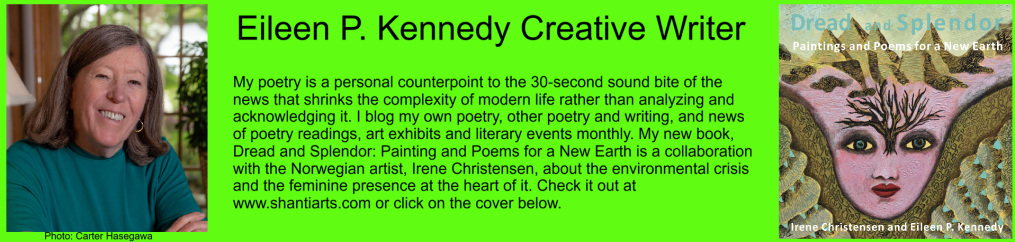
I followed this organization when I complied my upcoming manuscript Dread and Splendor: Paintings and Poems for a New Earth. It is about women at the heart of the environmental crisis and will be published by Shanti Arts in early 2026. Follow me here as I blog more about manuscripts and the publishing process. I will blog once a month.
 Eileen P. Kennedy Author